Q3 2026 Superyacht Market Report
As we reach the end of the third quarter of 2026, this report offers an overview of activity across the global superyacht market, drawing on insights from Northrop & Johnson’s Deep Data Department. Covering the pre-owned brokerage sector, new construction and charter, it examines the trends that have shaped the first nine months of the year and the factors influencing market activity as we enter the final quarter.
The figures present a mixed picture. Brokerage transaction volumes have remained relatively stable, although overall sales values have declined, while an increase in new listings and price reductions reflects a market in which buyers have considerable choice. New-build activity has moderated, with demand varying across size categories, while the charter sector has recorded year-on-year growth, particularly during the earlier part of the Mediterranean summer.
As always, these figures should be viewed in context. Individual transactions can have a significant influence on market performance, particularly at the upper end, and the data continues to evolve as further sales are reported. Our aim is not simply to identify changes in the numbers, but to provide a clearer understanding of what they may tell us about the market.
We hope this latest report provides useful insight and perspective as we look towards the close of 2026.

Cromwell Littlejohn
President & CCO
Global Brokerage Market
Global Sales Overview
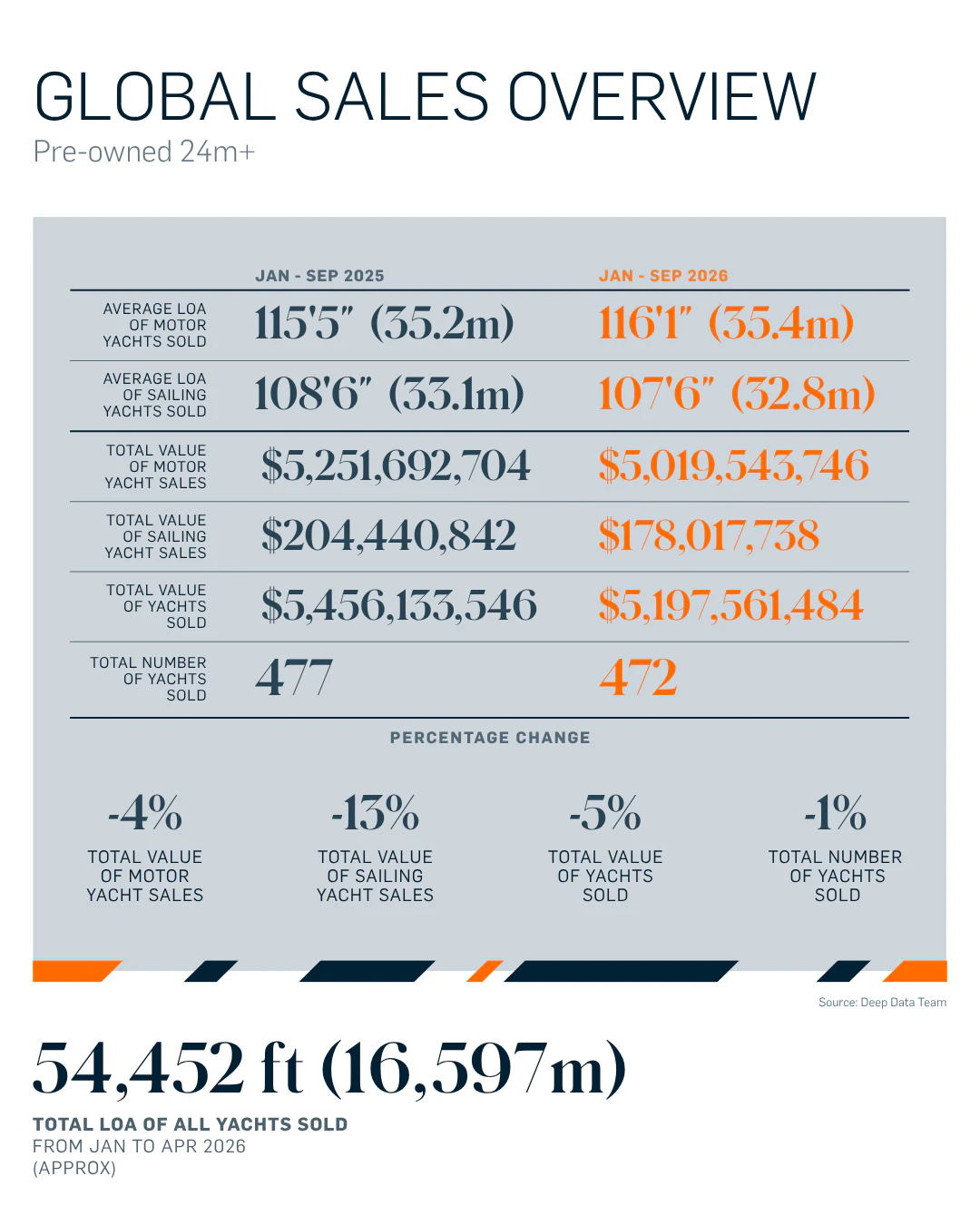
Yachts sold, 78’+ (24m) 24m+ 472 Down 1.0% YoY
Total sales value $5.2 bn Down 4.7% YoY
New central agencies 1,400 Up 5.5% YoY
Global sales of pre-owned yachts measuring 78’ (24m) and above reached 472 during the first nine months of 2026, compared with 477 over the same period in 2025. Although the number of transactions declined by just 1 percent, total sales value fell from $5.46 billion to $5.20 billion, a reduction of approximately 4.7 percent.
Motoryachts continue to account for the overwhelming majority of the market, generating $5.02 billion in sales, down 4 percent year-on-year. Sailing yacht sales totaled $178 million, a decline of 13 percent.
The average length of motoryachts sold remained broadly unchanged at 116’1” (35.4m), compared with 115’5” (35.2 m) in 2025, while the average sailing yacht sold measured 107’6” (32.8m).
Global sales volumes have remained close to last year’s levels, while aggregate sales value is lower. The difference warrants caution when assessing performance across the upper end of the market.
2025 vs 2026 Market Snapshot
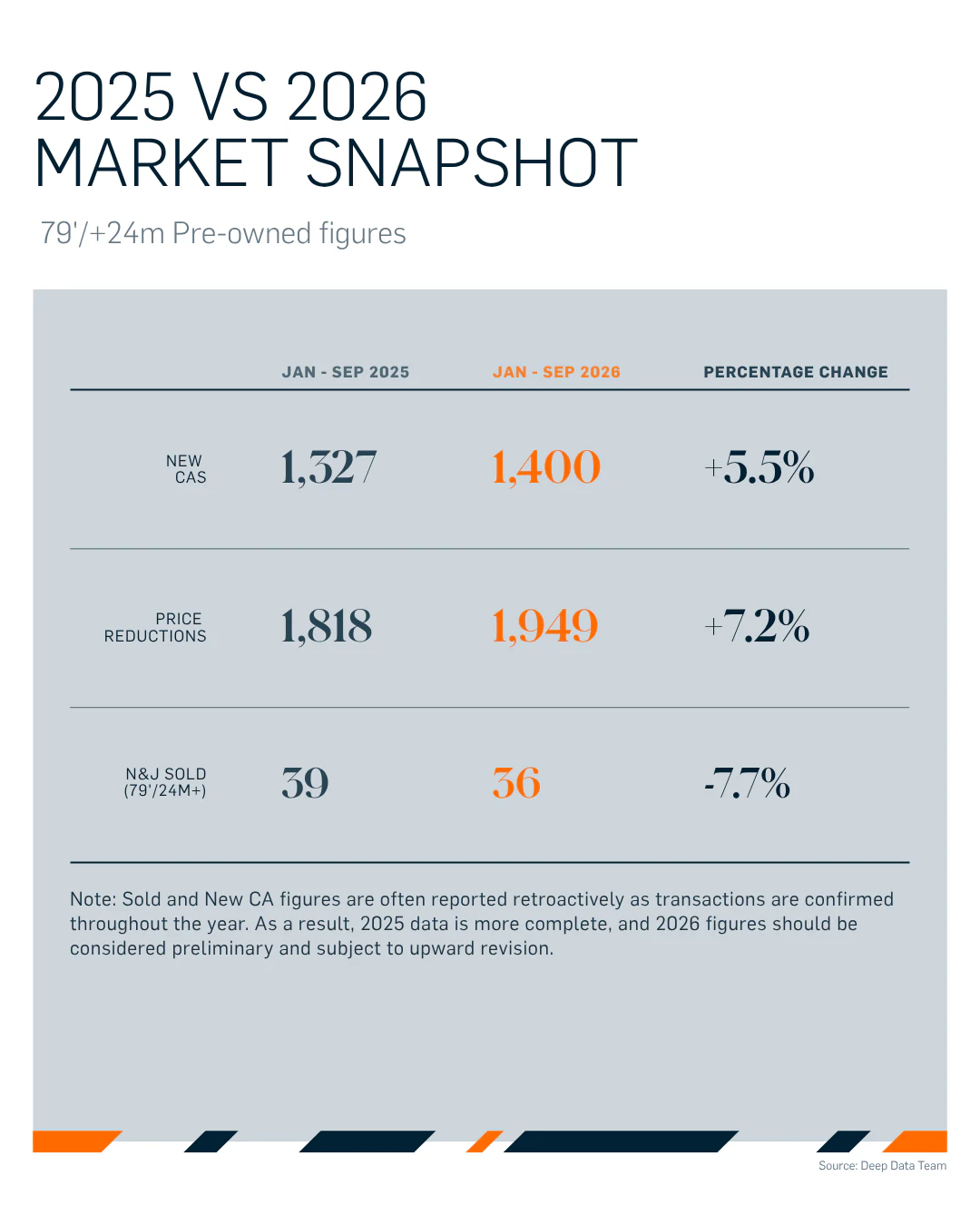
The relative stability in sales volumes contrasts with increased activity on the supply side of the brokerage market. During the first nine months of 2026, 1,400 yachts entered the market as new central agency listings, an increase of 5.5 percent compared with 1,327 during the same period last year. Price reductions also increased, rising 7.2 percent from 1,818 to 1,949.
With more yachts coming onto the market and sellers increasingly adjusting their asking prices, competition remains considerable. For buyers, the greater choice of available yachts creates opportunities, particularly where owners are prepared to respond to market conditions. For sellers, realistic pricing from the outset remains important, especially for yachts competing within well-supplied size categories.
Brokerage Sales by Size Range
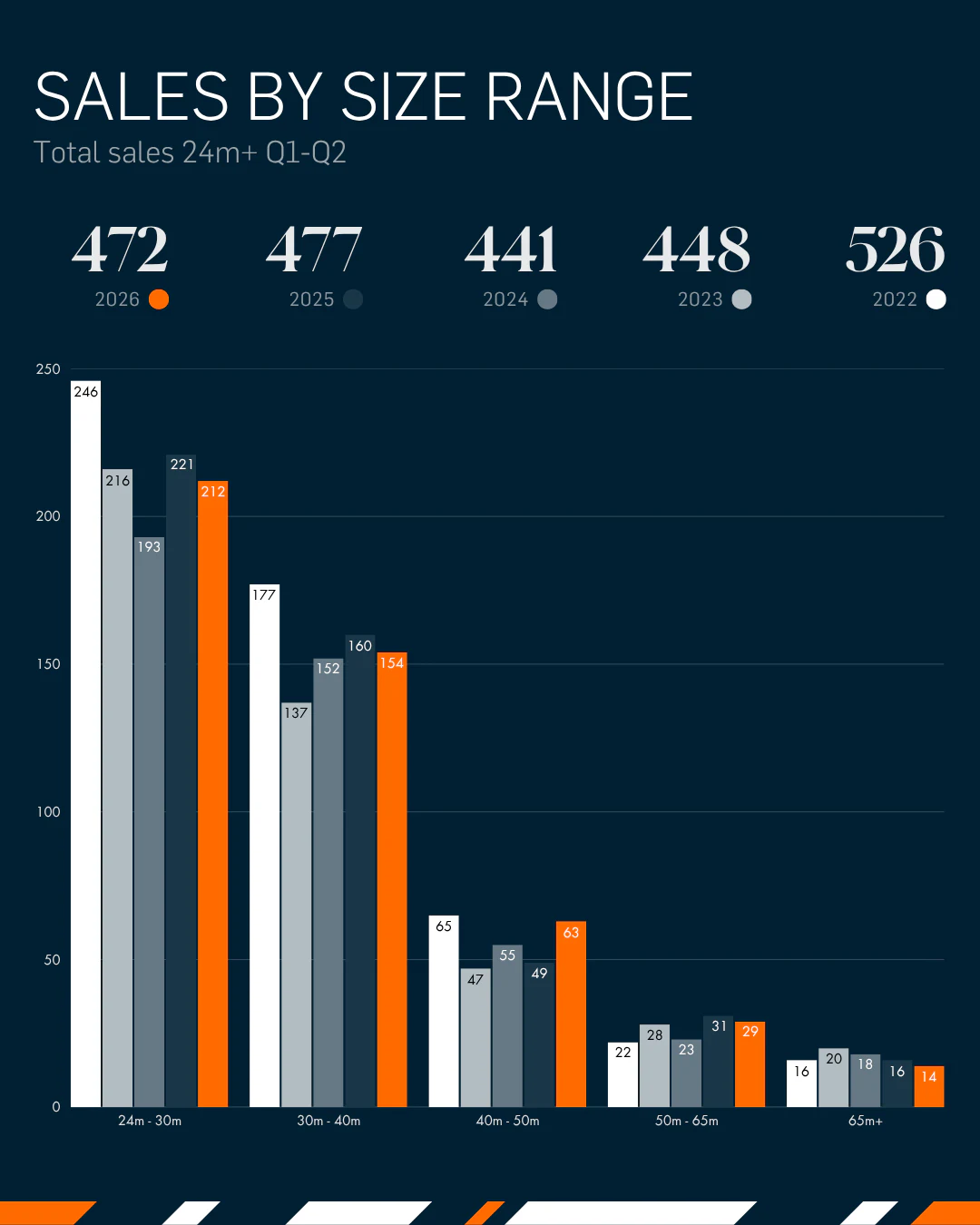
Sales performance varied across the principal size categories, with the 131’ – 164’ (40m – 50m) segment emerging as the strongest performer.
The smaller 78’ – 98’ (24m – 30m) and 98’ – 131’ (30m – 40m) categories recorded fewer sales than in 2025, although they continue to account for the majority of transactions. By contrast, the 131’ – 164’ (40m – 50m) segment increased from 49 to 63 sales, a rise of approximately 29 percent.
Sales of yachts measuring 164’ – 213’ (50m – 65m) and above were lower than last year, underlining the uneven nature of demand across the upper end of the market.
The growth in the 131’ – 164’ (40m – 50m) category is particularly notable given the softer performance elsewhere. It indicates that demand remains present for larger yachts, but is concentrated in specific segments rather than extending evenly across the market.
Brokerage Sales by Age Range
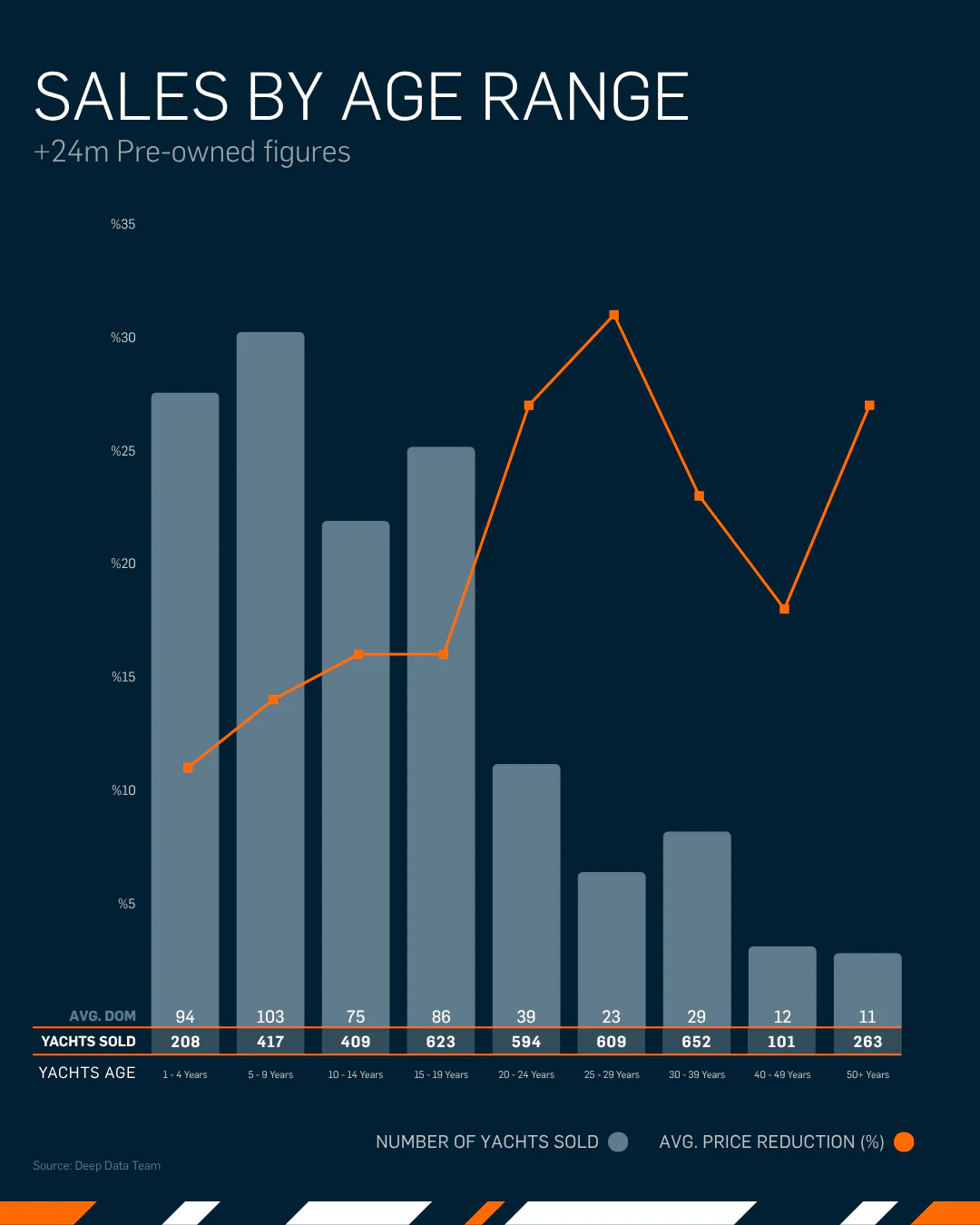
The age of yachts sold offers further insight into buyer preferences and the importance of pricing. Yachts between five and nine years old recorded the highest number of sales during the period, with 103 transactions, followed by yachts aged up to four years, with 94 sales. Together, these categories accounted for approximately 42 percent of the pre-owned market.
Time on market varies considerably between age groups, although individual transactions and small samples can influence the averages. The greatest pricing pressure was recorded among yachts aged 25 to 29 years, where the average price reduction reached 31.1 percent.
These differences underline the importance of assessing each yacht individually. Build quality, maintenance history, refit investment, condition and asking price can all influence a yacht’s marketability, irrespective of age.
New Central Agency Listings and Price Reductions
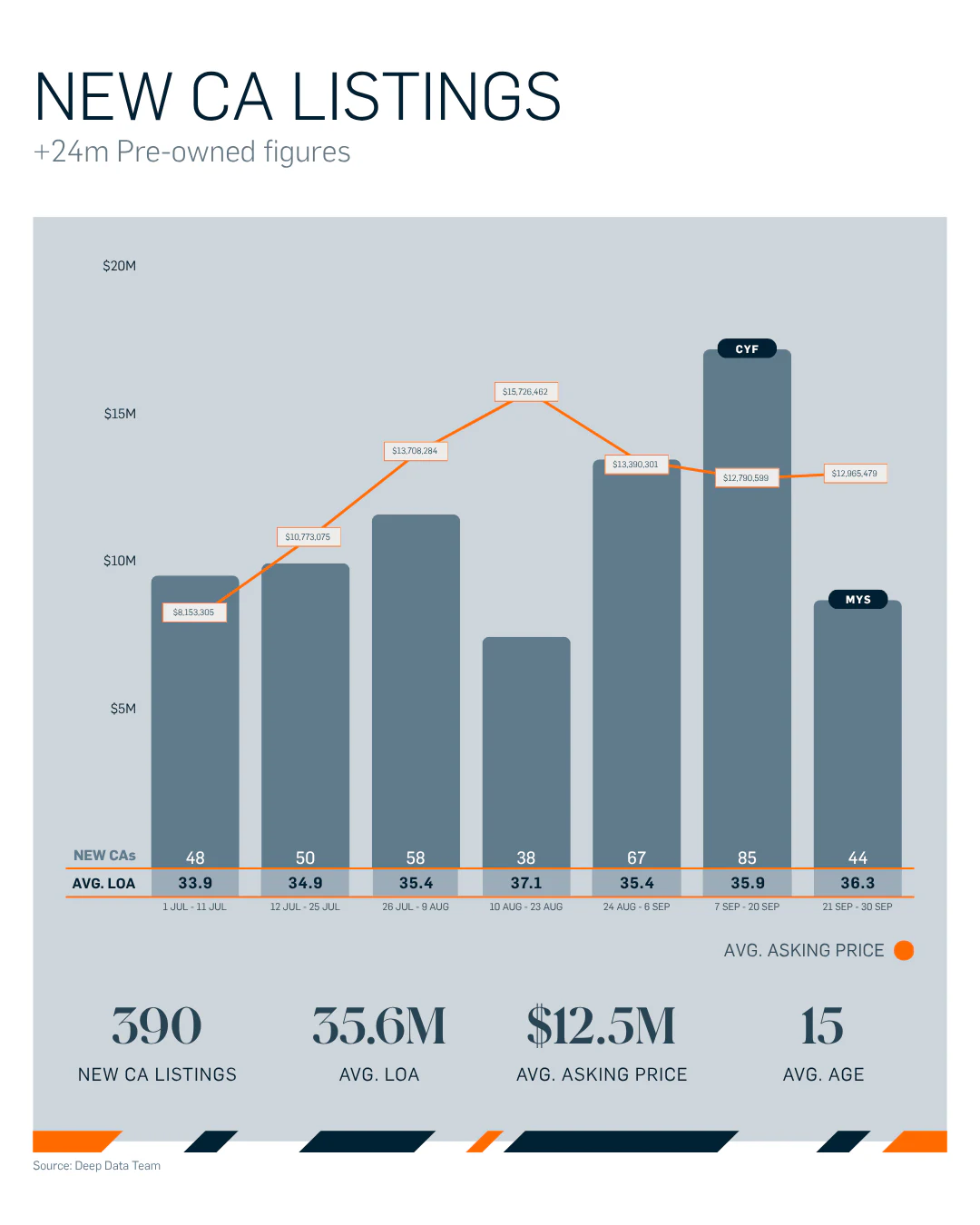
New listing activity increased during Q3, with 390 yachts over 78’ (24m) entering the brokerage market. The average asking price was approximately $12.5 million, with an average length of 116’5” (35.6m).
Activity was particularly evident around the Cannes Yachting Festival and Monaco Yacht Show in September, traditionally important dates for owners and brokers bringing yachts to market ahead of the fall season.
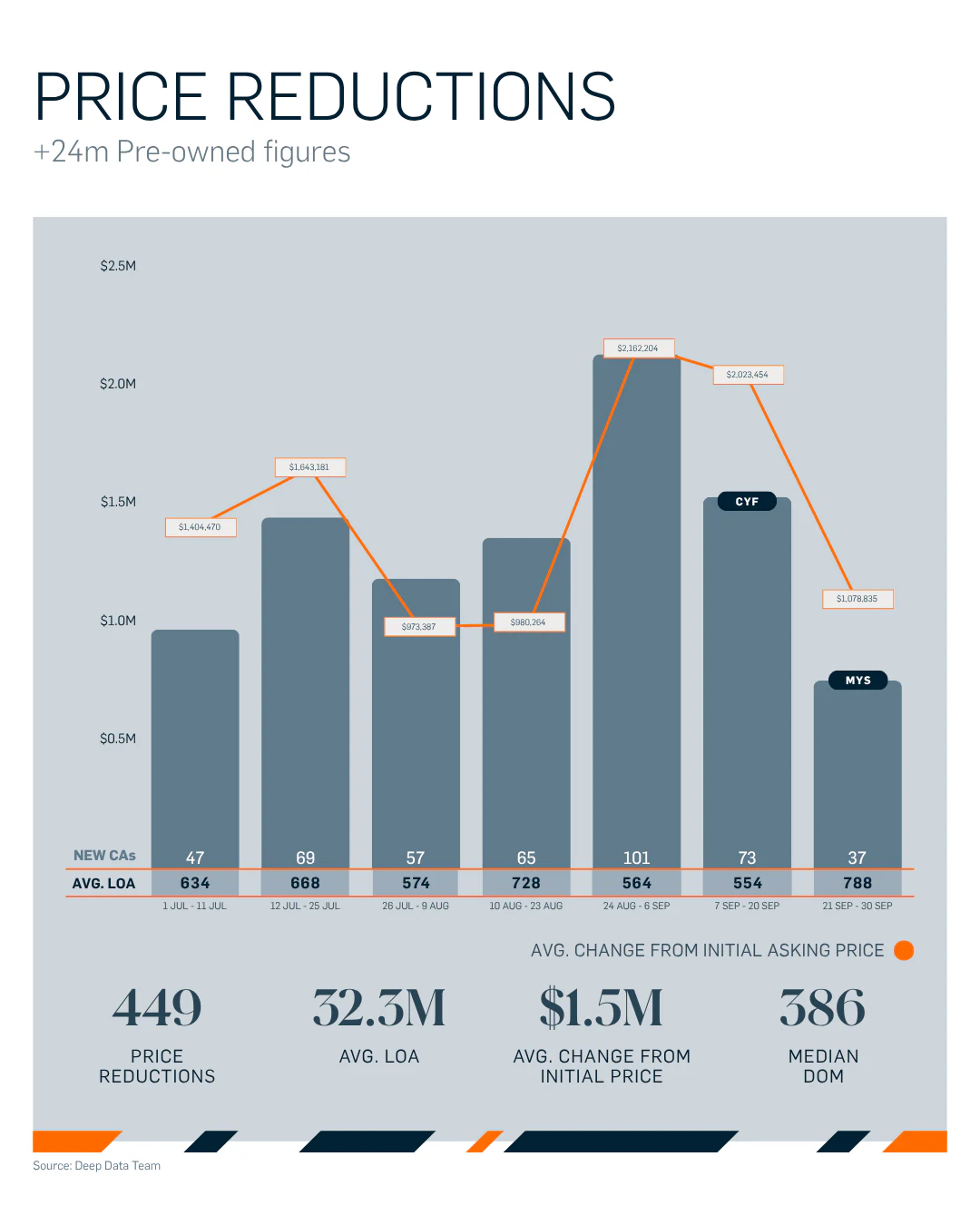
Price reductions were also prominent, with 449 recorded during the quarter. The average reduction was approximately $1.5 million, while the median time on market for yachts receiving reductions stood at 386 days. The largest concentration of reductions occurred in late August and early September, when 101 price adjustments were recorded during a two-week period.
The increase in price adjustments coincided with the fall yacht shows, although the data does not establish a direct connection.
Brokerage Activity
Q3 2026 vs Previous Quarter
Brokerage activity slowed during the third quarter, with 126 pre-owned yachts over 78’ (24m) sold globally between July and September, compared with 160 during Q2.
Despite the reduction in volume, the average last asking price of yachts sold increased from $9.9 million to $12.4 million. The average time on market also improved, falling from 542 days in Q2 to 445 days in Q3.
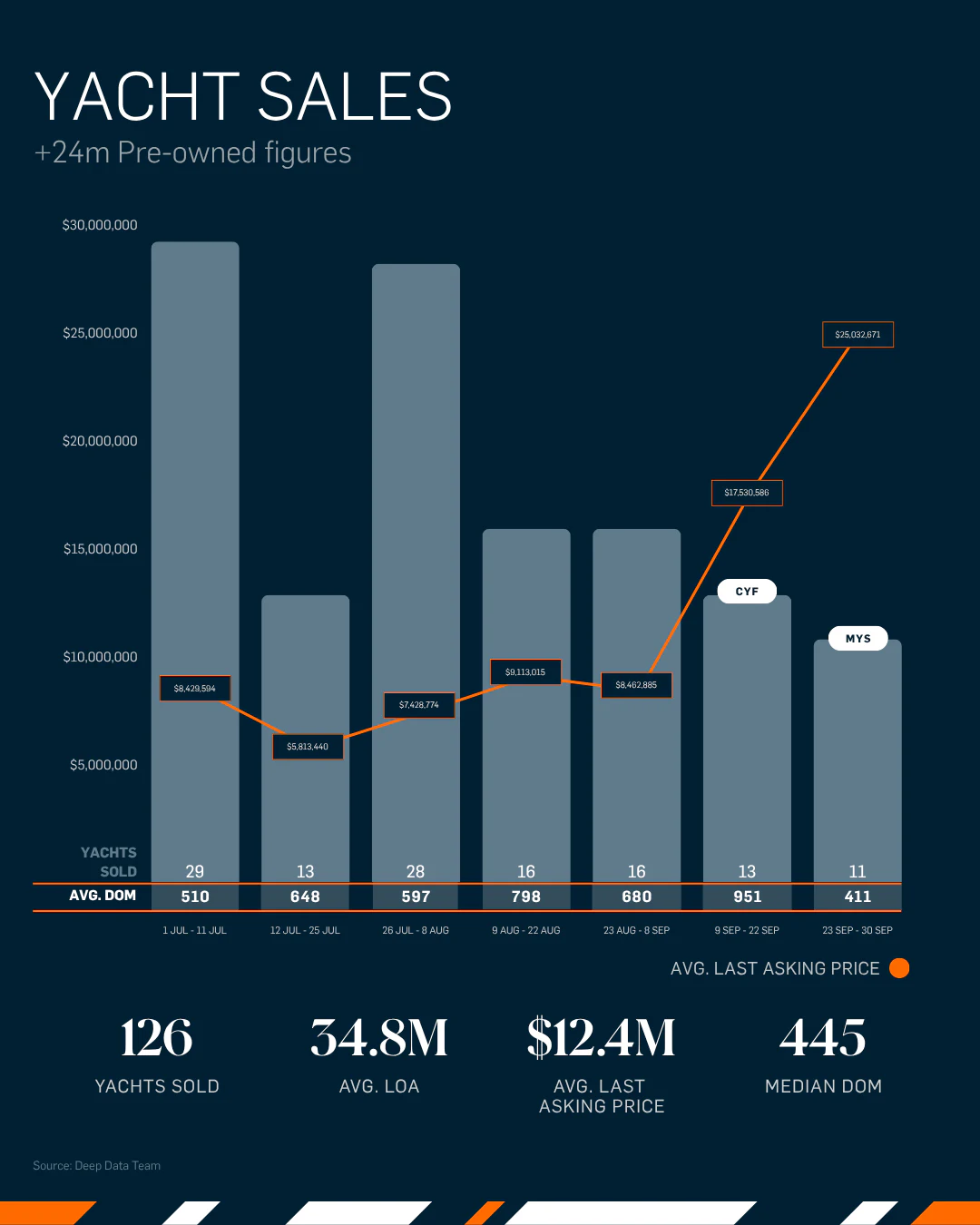
Q3 yachts sold: 126, down 21.3% from Q2
Average last asking price: $12.4m, up from $9.9m
Average days on market: 445, down from 542 days
Higher-value transactions towards the end of September contributed to the increase in average asking values. Although fewer yachts changed hands, the improvement in average time on market suggests that some well-positioned yachts continued to find buyers. Nevertheless, the quarter’s stronger average values were influenced by a relatively small number of significant transactions, rather than a broad recovery across all segments.
Northrop & Johnson Sales Activity
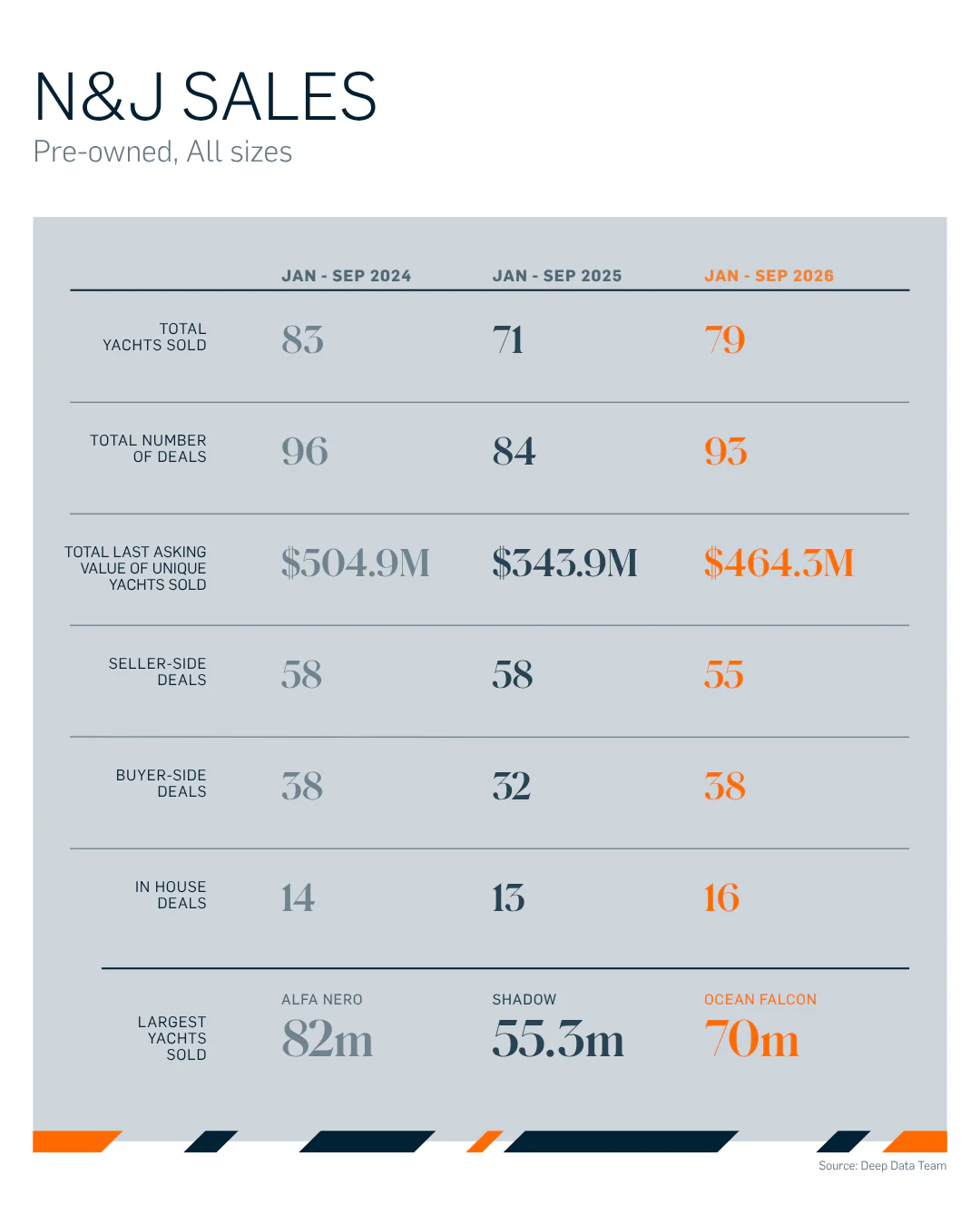
Northrop & Johnson completed 36 sales of yachts measuring 78’ (24m) and above during the first nine months of 2026, compared with 39 over the corresponding period last year.
The company’s third-quarter activity included sales across both motor and sailing yacht categories, with transactions ranging from established pedigree yachts to more recently delivered models.
Notable sales during the quarter included the 208’ (63.5m) Benetti CONFIDENTIAL, the 164’ (49.99m) ISA-built LIBERTY and the 142’7” (43.5m) Eurocraft BARON TRENCK. Other transactions included FAR NIENTE, AROHA, BLUE AZUR, NORFOLK STAR and GUSTO II.
The range of yachts sold illustrates the breadth of the company’s brokerage activity, from large motor yachts to sailing yachts and smaller vessels within the core brokerage market.
Northrop & Johnson New Central Agencies
Northrop & Johnson also expanded its sales portfolio during Q3, adding a selection of motor and sailing yachts across several size categories.
Among the larger additions were the 165’ (50.4m) Feadship EMERALD, the 163’6” (49.89m) Feadship KORU and the 160’ (48.77m) Trinity NO BAD IDEAS. Other notable new listings included the 153’ (46.63m) KAJAK, the 141’ (43m) CRN TITIAN PEARL and the 124’ (37.8m) Delta Marine FORE ACES.
The additions include both recent builds and refitted yachts, further broadening the company’s sales portfolio across a range of sizes and styles.
New Construction Market
New-Build Sales Overview
The new-construction market recorded 216 reported sales of yachts measuring 78’ (24m) and above during the first nine months of 2026, compared with 266 over the corresponding period in 2025.
Although the figures indicate a reduction in activity, new-build reporting typically develops retrospectively as additional shipyard transactions are confirmed. The 2026 total should therefore be considered provisional.
The slowdown has not been uniform across the market. While several smaller and intermediate size categories recorded fewer sales, the 164’ – 197’ (50m – 60m) segment increased from 12 to 16 sales, representing growth of approximately 33 percent.
Both custom and speculative construction contributed to activity in this category, indicating continued interest in larger projects despite a more cautious overall market.
New Build Sales Year-On-Year 78’+ (24m+) Jan – Sep
2021 – 372 (505 – 73%)
2022 – 397 (489 – 81%)
2023 – 310 (424 – 73%)
2024 – 286 (398 – 76%)
2025 – 266 (356 – 75%)
2026 – 216
More yachts will be identified in the coming months
New-Build Sales by Size Range
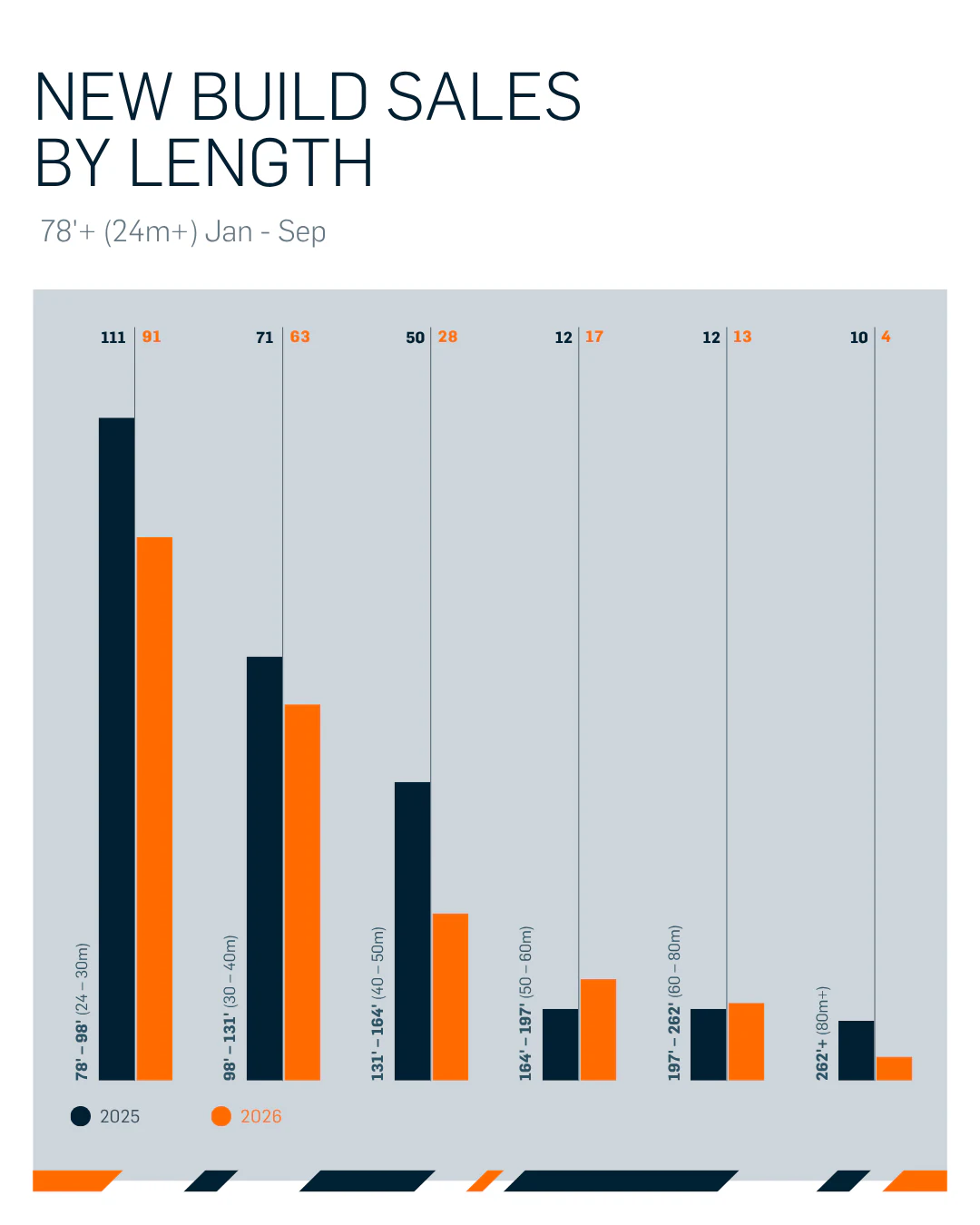
The 78’ – 98’ (24m – 30m) category remained the largest by number of transactions, with 91 reported sales, compared with 112 during the same period last year.
The 98’ – 131’ (30m – 40m) segment recorded 63 sales, down from 71, while the 131’ – 164’ (40m – 50m) category declined more noticeably, from 51 to 28.
By contrast, the 164’ – 197’ (50m – 60m) category was the only size range to record growth, increasing from 12 to 16 sales. Sales of yachts between 197’– 262’ (60m – 80m) fell from 12 to six, while the 262’ (80m) and above category remained unchanged at ten.
The figures indicate that new-build demand is increasingly selective, with the strongest year-on-year performance concentrated in the 164’ – 197’ (50m – 60m) segment.
Custom and Speculative Construction
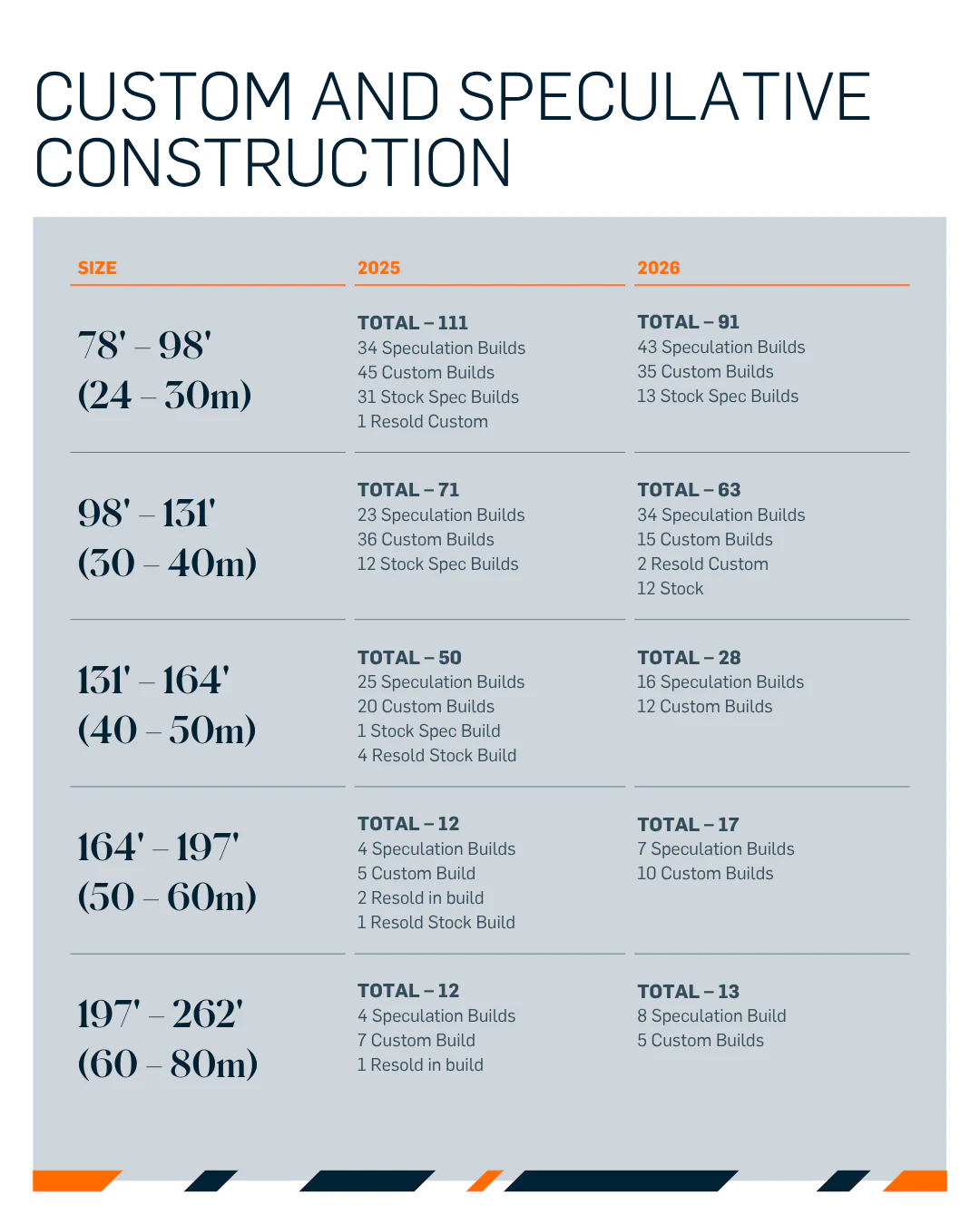
The composition of new-build sales also provides an indication of how the market is developing. Speculative construction accounted for approximately 51 percent of reported activity during the first nine months of 2026, compared with 36 percent for custom projects.
Speculative construction allows buyers to acquire yachts already in development, potentially offering shorter delivery periods than a fully bespoke commission. This may be particularly relevant where clients are reluctant to commit to lengthy construction programs.
Custom construction nevertheless remains an important part of the market, particularly among larger yachts where owners place greater emphasis on individual design requirements and long-term ownership plans.
European Yacht Shows
The fall yacht shows provided an opportunity to assess the latest developments in new construction. At the 2026 Cannes Yachting Festival, 33 shipyards and brands presented 60 new-build yachts measuring 78’ (24m) and above, including two identified world premieres. Azimut had the largest representation, followed by Sanlorenzo.
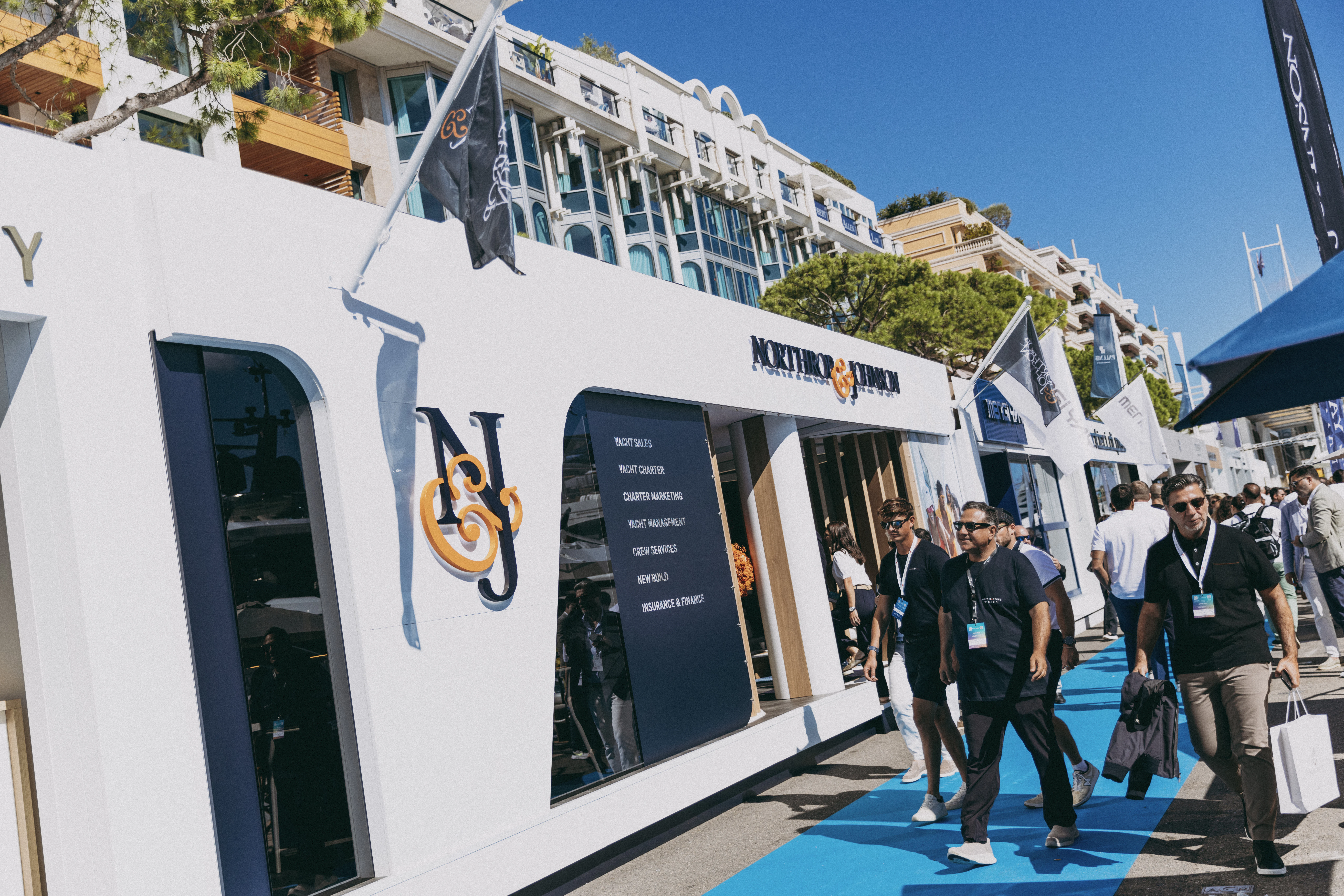
The Monaco Yacht Show brought together 33 shipyards and brands, displaying 44 new-build yachts 78’ (24m) and above, including first hulls, new model launches and projects from established superyacht builders.
While the number of yachts on display is not a direct measure of new-build demand, the shows remain an important opportunity for shipyards to introduce new projects and for buyers to assess available designs, construction programs and delivery schedules.
New Construction Outlook
The new-build market continues to show differences between size categories and construction types. The reported decline in sales through September should be considered alongside the provisional nature of the data, as further transactions are likely to be identified. Nevertheless, the stronger performance of the 164’ – 197’ (50m – 60m) category contrasts with reduced activity across much of the smaller yacht market.
Delivery schedules, construction costs and the availability of projects already under way remain important considerations for buyers evaluating a new-build commission.
The Global Brokerage Fleet
The Brokerage Fleet Today
As of 1 October 2026, the global superyacht fleet comprised approximately 12,775 yachts, with a combined length of 1,429,688’ (435,769m) and total volume of more than 3.7 million gross tons.
Of these, 2,197 pre-owned yachts were listed for sale, representing 17.2 percent of the global fleet.
Global fleet 12,775
Total fleet length 1,429,688’ (435,769m)
Average length 111’8” (34.1m)
Total volume 3,741,108GT
Average volume 299.8 GT
Average build year 2005
Brokerage fleet 2,197
17.2% of global fleet currently for sale
Total Brokerage fleet length 246,394’ (75,101m)
Brokerage fleet average length 112’2” (34.2m)
Brokerage fleet total volume 565,671GT
Brokerage fleet average volume 258.4 GT
Brokerage fleet average build year 2008
Motoryachts account for the majority of available inventory, with 1,928 yachts listed for sale, representing 87.7 percent of the market. The remaining 269 are sailing yachts.
The average length of a yacht currently offered for sale is 112’1 (34.2m), closely aligned with the global fleet average of 111’8” (34.1m). The average build year of yachts for sale is 2008, compared with 2005 for the overall fleet.
With more than one in six yachts currently offered for sale, buyers continue to have considerable choice. However, the distribution of inventory varies significantly by size and value.
Brokerage Fleet by Size Segment
The 78’ – 131 (24m – 40m) market accounts for the largest proportion of yachts available for sale, with 1,749 listings across the two size categories. This represents approximately 80 percent of the pre-owned brokerage fleet.
The 78’ – 98’ (24m – 30m) segment alone comprises 1,005 yachts, with a reported market value of approximately $3.8 billion and an average asking price of $3.9 million.
The 98’ – 131’ (30m – 40m) category contains 744 yachts, representing approximately $4.8 billion in asking value, with an average price of $6.6 million.
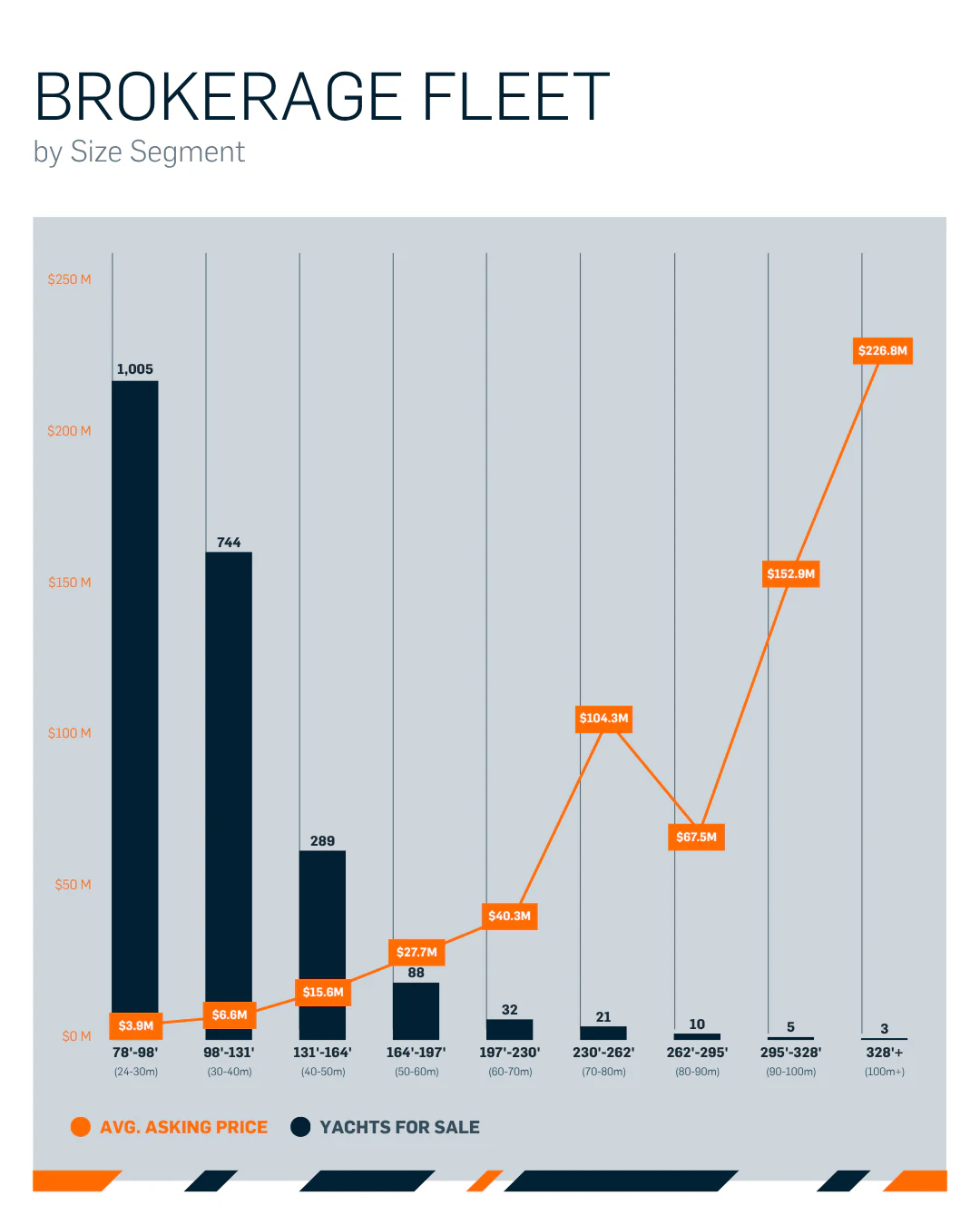
The 131’ – 164’ (40m – 50m) segment contains 289 yachts, with an average asking price of approximately $15.6 million. Beyond 164’ (50m), inventory becomes progressively more limited, although individual yachts account for a significantly greater proportion of the market’s overall value.
For buyers, the figures highlight the breadth of choice within the 78’ – 131’ (24 – 40m) market, where competition among sellers remains substantial. At the upper end, opportunities are fewer and the market is more dependent on individual yachts, their pedigree and condition.
Market Value & Pricing 78’+ (24m+)
Total market value – $19.5 billion
Motor yacht value – $17.8 billion
Sailing yacht value – $1.7 billion
Average asking price – $9.7 million
Charter Market
Charter Market Overview
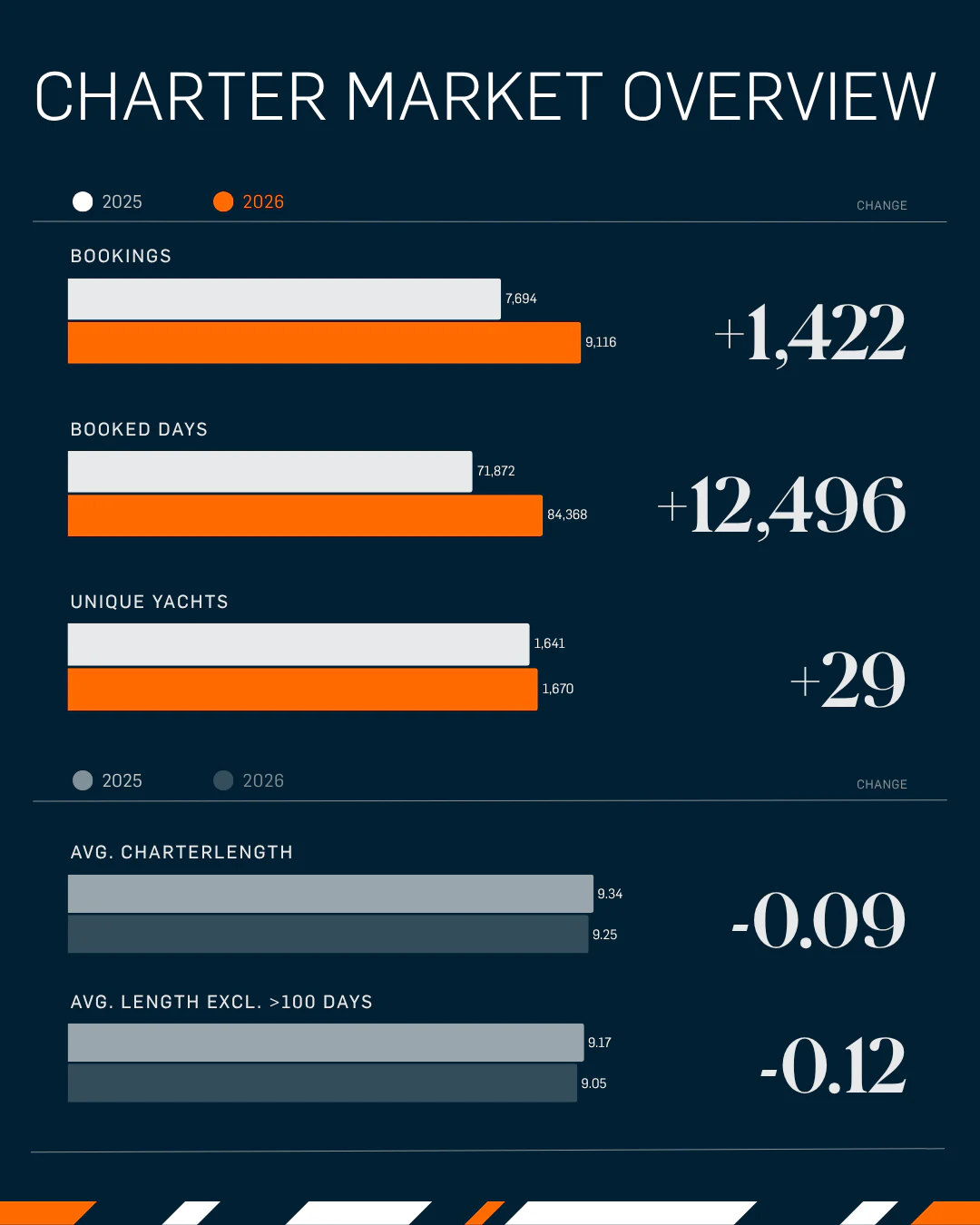
The global charter market recorded an 18.5 percent increase in bookings during the first nine months of 2026 compared with the same period in 2025.
Growth was concentrated in June and July, reflecting a stronger early and mid-summer season. This follows the unusual booking patterns observed earlier in the year, when geopolitical uncertainty and concerns surrounding travel appeared to contribute to shorter booking lead times.
While charter bookings increased by 18.5 percent, the number of individual yachts receiving bookings rose by just 1.8 percent, from 1,641 to 1,670. Booked days increased by 17.4 percent. The growth in activity therefore came primarily from more bookings across a broadly similar number of yachts.
Charter Demand by Travel Period
June and July accounted for much of the increase in booking activity. These figures describe when bookings were recorded and should not be read as a direct measure of departure dates. The booking pattern is unusual, but it is too early to establish whether it will continue in future seasons.
Cruising Grounds
The Mediterranean remained the principal focus of global charter demand, although regional booking patterns varied.
The East Mediterranean and Adriatic together accounted for more bookings than the West Mediterranean in the first nine months of 2026. Split recorded the strongest identifiable increase among individual embarkation locations, with 143 more bookings than in 2025. Athens remained the leading pickup location in both years, reinforcing Greece’s importance to the Mediterranean charter market.
Not all destinations recorded growth. Naples was among the few major embarkation locations to experience a decline, with 42 fewer bookings than during the same period last year.
Outside the Mediterranean, the Caribbean and The Bahamas both recorded booking growth of approximately 19 percent, although their respective shares of the overall market remained largely unchanged.
These regional differences highlight the importance of distinguishing between absolute booking growth and changes in market share. While certain destinations recorded stronger increases, the Mediterranean continues to account for the majority of global charter activity.
Charter Market Outlook
Charter bookings and booked days both increased during the first nine months of 2026. The Mediterranean remained the dominant cruising region, although performance varied between destinations.
Shorter booking windows earlier in the year appear to reflect caution over travel planning amid geopolitical uncertainty. This should not be taken to mean that preferred yachts and peak dates will routinely remain available at short notice.
Overall Market Outlook
Global brokerage transaction volumes remained close to 2025 levels through September, although total sales value declined. Increased listings and price reductions have kept pricing in focus, particularly in the more heavily supplied size categories.
The 131’ – 164’ (40m – 50m) category has been a notable exception, recording the strongest year-on-year growth in pre-owned sales, while new-build activity has shown greater resilience in the 164’ – 197’ (50m – 60m) range.
Charter activity presented a different picture, with both bookings and booked days increasing year-on-year. The final quarter will provide a fuller picture of whether brokerage activity strengthens towards year-end.
Source: Deep Data Team
Curated by: Miriam Cain & Christina Murphy
Read Next




Navigator Newsletter Stay informed on all things yachting and luxury lifestyle with the bi-monthly Navigator newsletters.
Sign up for Navigator newsletter