Inside the Early Charter Trends Shaping Summer 2026

As the Mediterranean charter season approaches, forward booking data through April suggests a more measured market than the same period last year, with booking patterns continuing to evolve in a more cautious market environment. While activity has picked up in recent weeks, the season began more slowly, with clients booking closer to departure and some demand shifting earlier in the calendar.
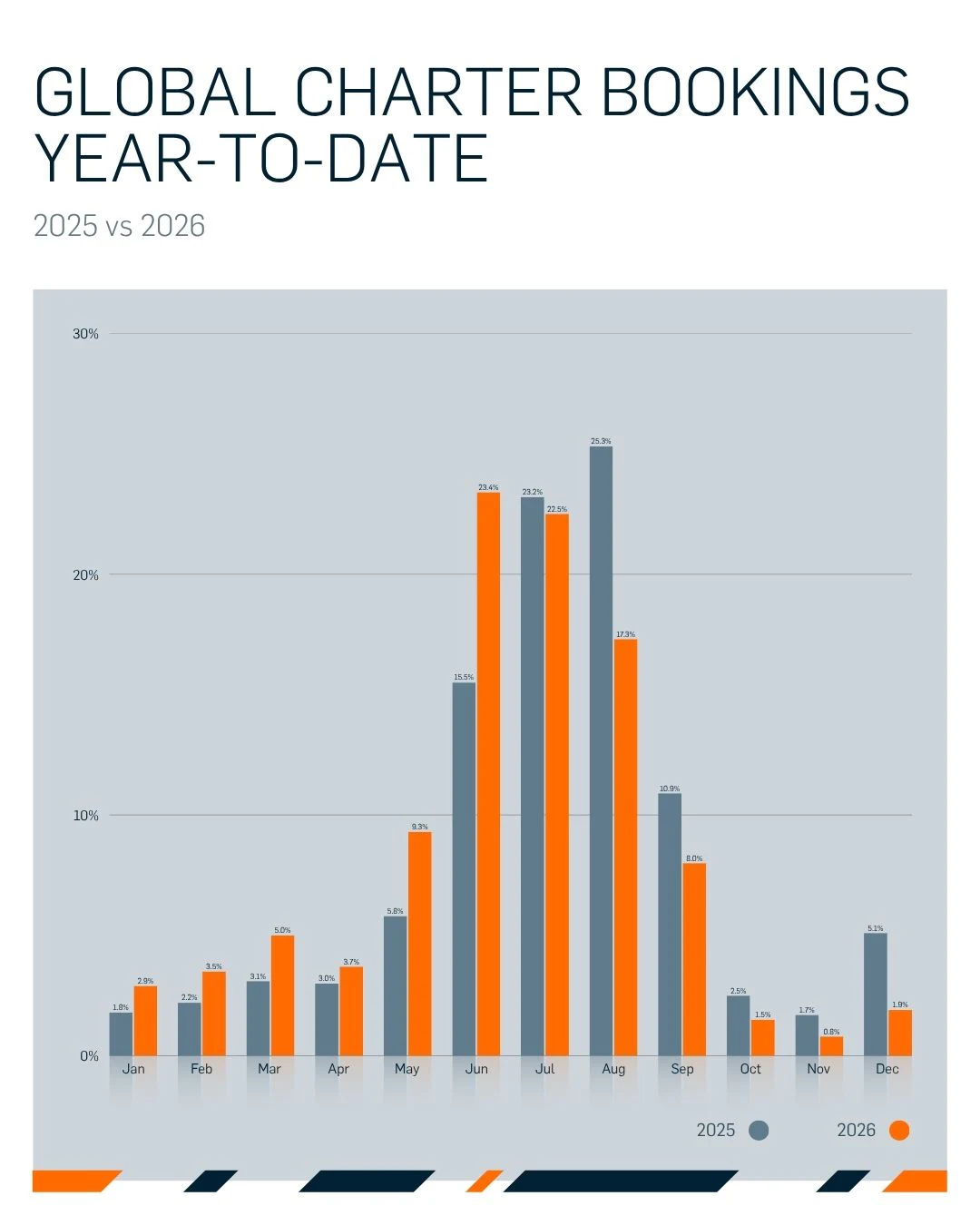
Forward booking data provides early visibility not only into demand levels, but also into when clients are choosing to charter during 2026. Charter demand has traditionally been concentrated around the July and August peak. While this remains the busiest period of the yachting calendar, current data suggests some shift in seasonal timing.
A total of 47.9 percent of booked charters have taken or are scheduled to take place in the first six months of 2026, compared to 31.3 percent for the same period in 2025. June has seen the most significant growth, increasing from 15.5 percent to 23.4 percent of total charter activity.
By contrast, July and August’s combined share has fallen from 48.5 percent to 39.9 percent, while August alone has declined from 25.3 percent to 17.3 percent. As the peak summer booking window remains open, these figures will continue to evolve, but current data suggests an earlier concentration of bookings within the season, with June emerging as a stronger month than in 2025.
This may reflect a combination of availability, shifting client preferences and greater flexibility around travel timing. For charter clients, this can create short-term opportunities in parts of the market, although availability can still tighten quickly as the season approaches.
Booking Behavior
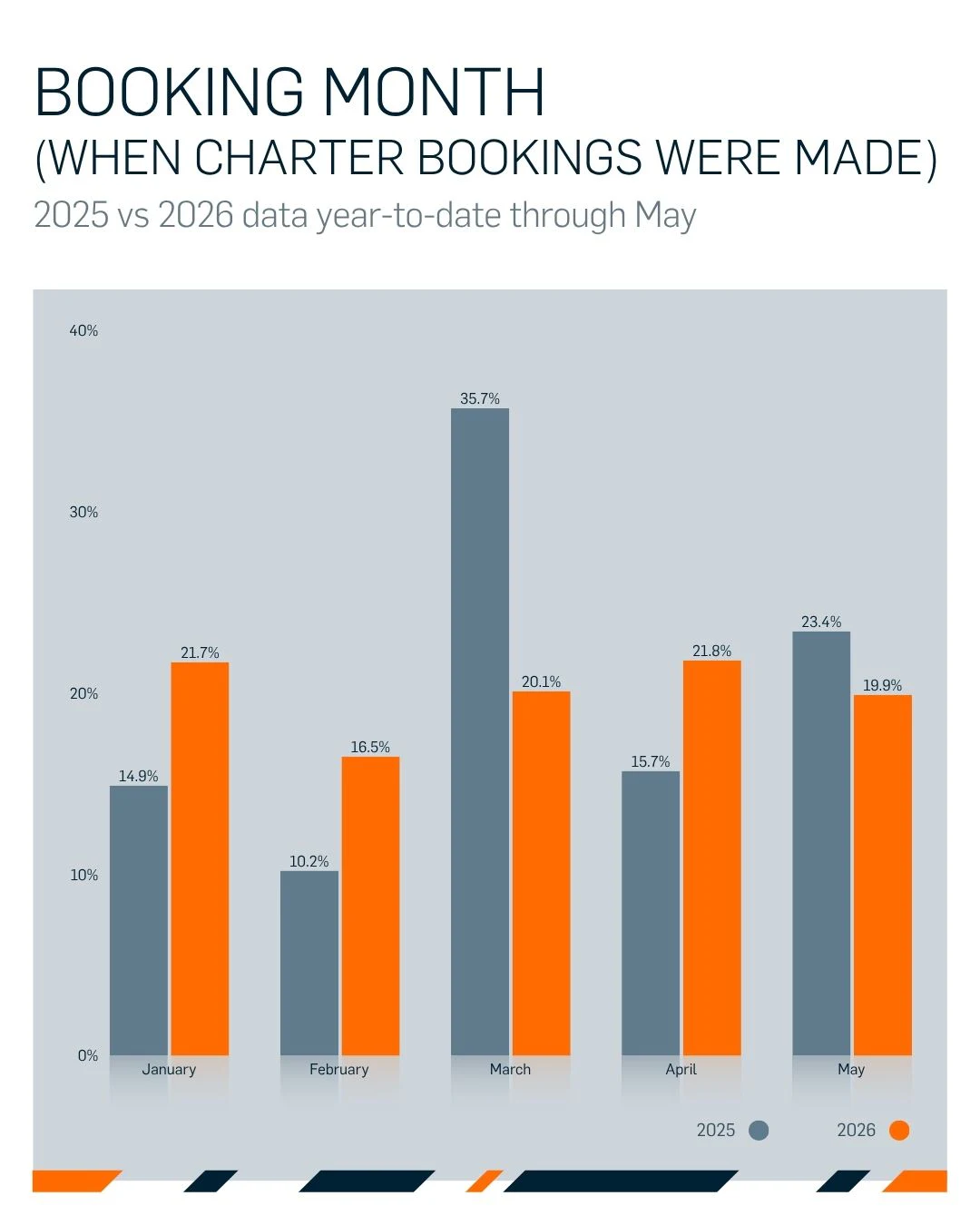
While the travel period analysis above shows when charters are due to take place, booking activity provides insight into when clients are actually making those charter decisions. March accounted for a smaller share of year-to-date bookings in 2026 than in 2025, suggesting a slower start to the spring booking period. However, April showed a marked recovery, with bookings increasing sharply year-on-year.
This points to a later booking pattern, with booking decisions shifting closer to departure. Against a backdrop of broader market uncertainty and economic caution, booking confidence appears to have returned more gradually rather than following the earlier momentum seen in previous years. For clients, this can create short-term opportunities, particularly where owners remain motivated to secure bookings, but availability can still tighten quickly as the season approaches.
Cruising Grounds & Regions
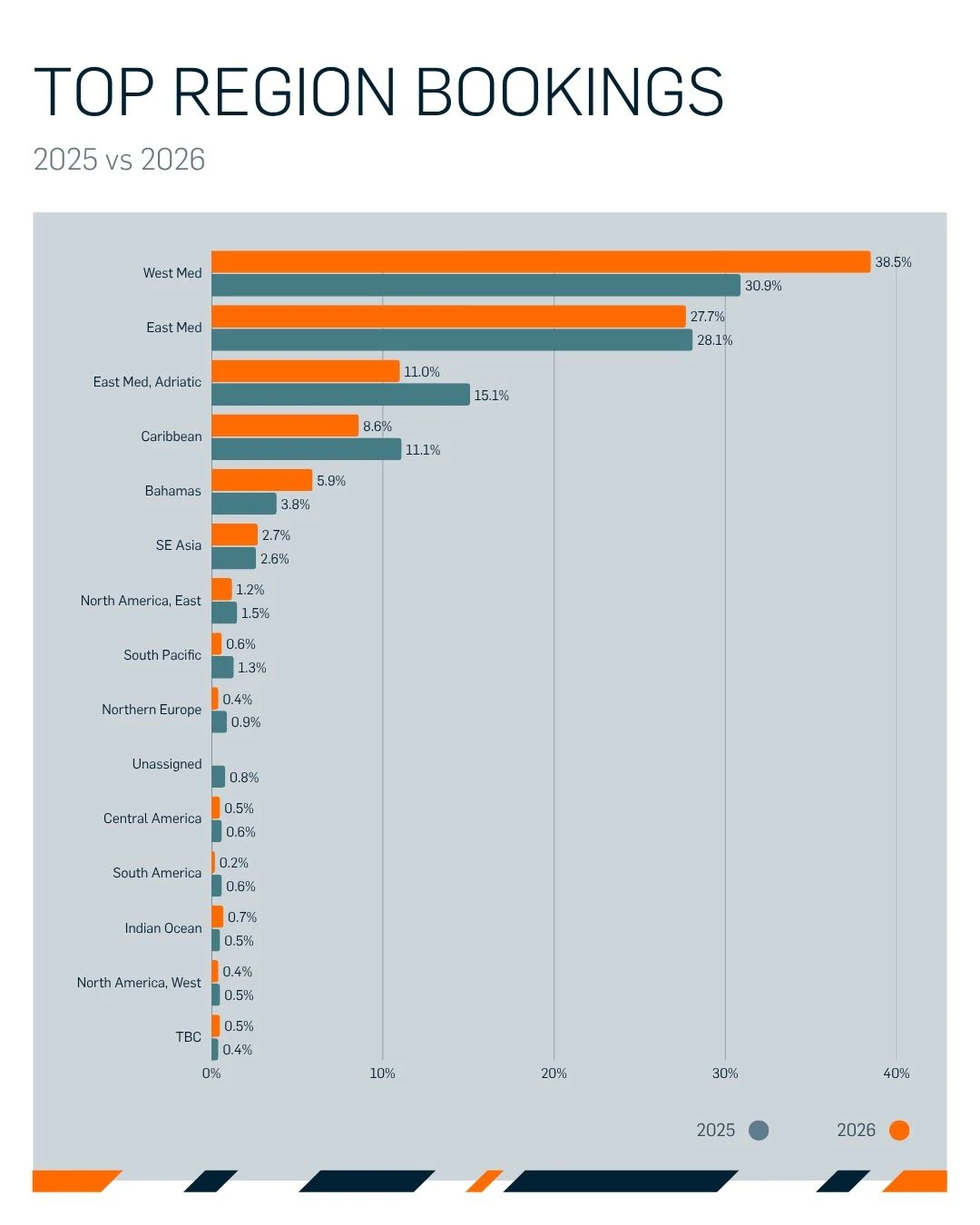
Cruising patterns remain mixed. Current Western Mediterranean bookings are running at approximately 60 percent of 2025 levels at the same stage, though the core summer booking window remains open. Broader regional uncertainty may have contributed to more cautious near-term booking behavior, particularly for Mediterranean itineraries.
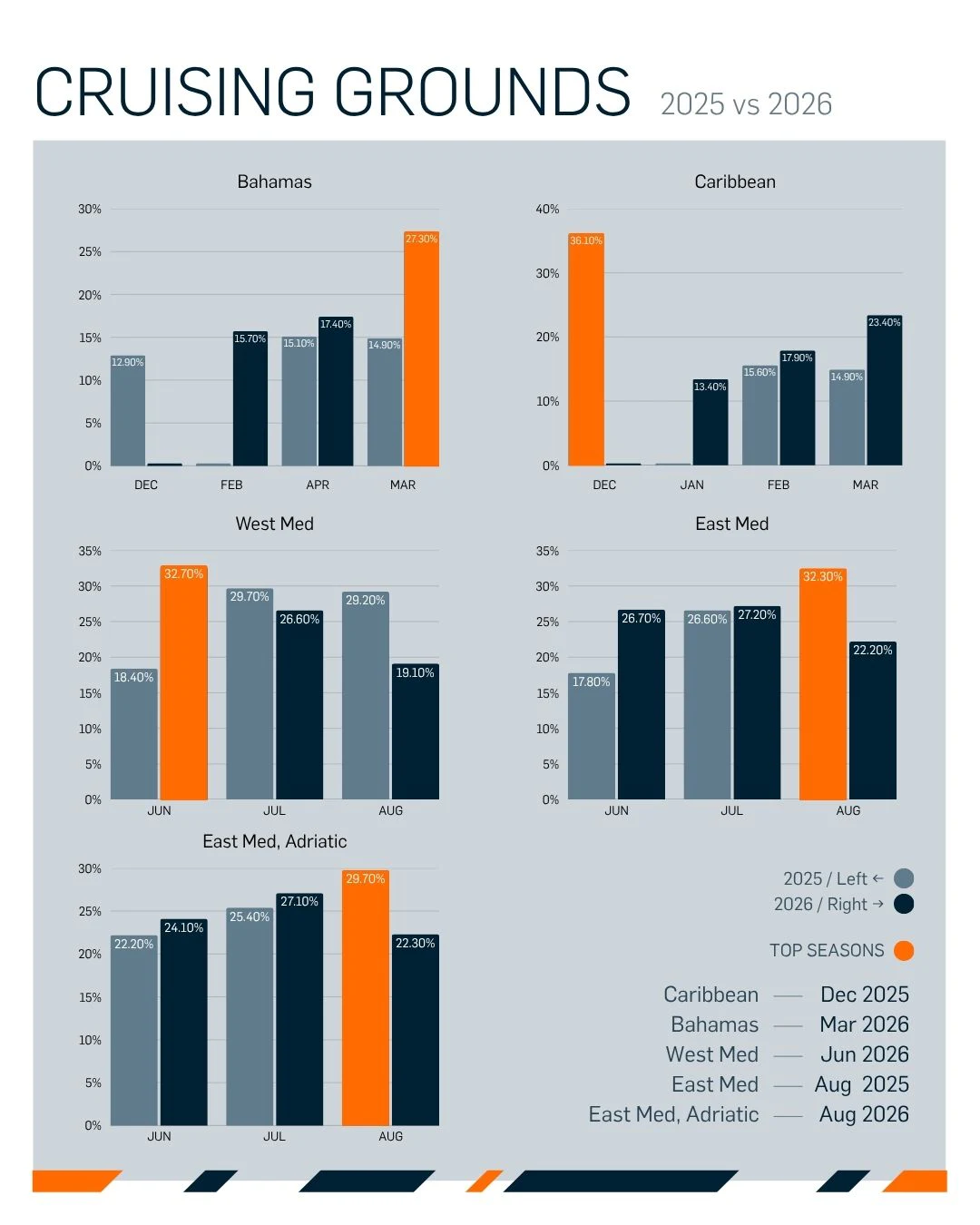
Within the Western Mediterranean itself, booking timing has also shifted. In 2025, demand was concentrated around the traditional July and August peak, whereas in 2026, June has emerged as the strongest month, accounting for 32.7 percent of Western Mediterranean charter bookings.
This may indicate a shift in seasonal timing rather than a simple reduction in demand, although booking patterns will continue to evolve through the core summer window.
Yacht Types
When looking at the size of yachts being booked, distribution remains relatively consistent year-on-year, with only modest movement between size categories.
The 78’–98’ (24m – 30m) segment declined slightly, from 25.8 percent to 22.7 percent, while the 98’-131’ (30m – 40m) segment strengthened slightly, from 30.6 percent to 32.2 percent. The 131’–164’ (40m – 50m) segment has also increased from 23.9 percent to 25.4 percent, while the 164’–214’ (50m – 65m) segment showed a smaller uplift from 13.8 percent to 14.9 percent. The 214’+ (65m+) segment eased slightly from 5.9 percent to 4.8 percent, though this remains a comparatively smaller and more specialist part of the charter market.
Unlike the brokerage sector, where transactional activity has increasingly shifted upward into larger yachts, charter demand remains centered around the established core 98’–164’ (30m–50m) fleet, with no significant structural change in size preference.
Northrop & Johnson Activity & Charter Market Outlook
Northrop & Johnson’s charter activity reflects these broader trends, with inquiry levels strengthening in recent weeks, particularly across core Mediterranean charter programs.
Booking decisions appear to be shifting later, even as some travel demand moves earlier in the summer calendar. Regional booking patterns remain uneven, with the Western Mediterranean still central to global charter demand.
As with all forward-looking charter data, these observations should be viewed as indicative rather than definitive, particularly as booking momentum can shift quickly in the lead-up to peak season. However, current trends suggest a market that remains fluid, with booking behavior continuing to evolve as the core season approaches.
For charter clients, the current market presents a slightly different dynamic from previous years, with greater flexibility in some areas, but with the potential for availability to tighten quickly as confidence returns and summer approaches. While some additional flexibility remains in parts of the market, availability for the most sought-after yachts and peak dates can still tighten quickly.
When it comes to selecting a charter destination and planning the holiday of your dreams, Northrop & Johnson’s charter brokers will deliver the best selection of yachts for charter around the world.
Market insights and analysis are powered by data provided by Christina Murphy and Northrop & Johnson’s Deep Data team.
Read Next



Navigator Newsletter Stay informed on all things yachting and luxury lifestyle with the bi-monthly Navigator newsletters.
Sign up for Navigator newsletter