The Charter Market After a Strong Summer

With the main Mediterranean season drawing to a close, the first eight months of 2026 provide a much clearer picture of the charter market than was visible earlier in the year. Despite a cautious start and an increasingly compressed booking window, global charter activity ultimately gathered considerable momentum through the summer.
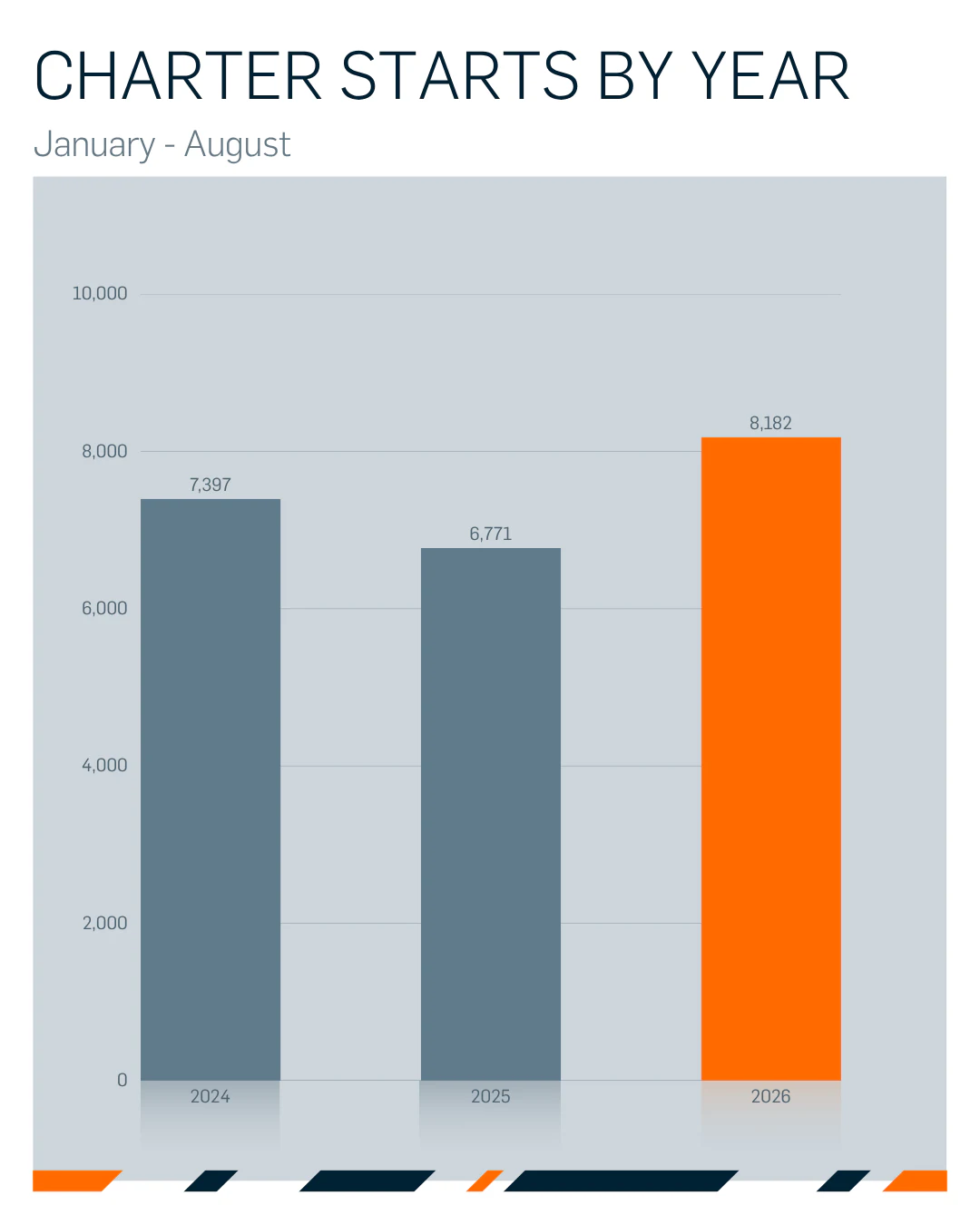
The defining feature of 2026 has been when clients chose to book. Decisions moved progressively closer to departure as the Mediterranean season approached, culminating in an exceptional last-minute surge in July. Yet despite that uncertainty, the first eight months ultimately delivered stronger charter activity than the same period last year.
By August, that pattern was beginning to change. Booking volumes eased as the peak Mediterranean season passed, while almost 45% of bookings made during the month were for charters taking place in 2027 or later.
Eight months into the year, the picture is therefore not simply one of stronger charter activity, but of a market operating across two very different booking horizons: clients prepared to wait until close to departure and those already securing their preferred yachts, dates and destinations for next year.
A STRONGER CHARTER MARKET
The first eight months show that the slower booking environment seen at the beginning of 2026 did not translate into fewer charters taking place.
Through July, global charter starts were already 30.5% ahead year-on-year, with booked days up 28.1%. With August now included, the year-on-year lead has moderated but remains substantial. January-to-August charter starts are 20.8% ahead of 2025, while booked days are 18.9% higher.
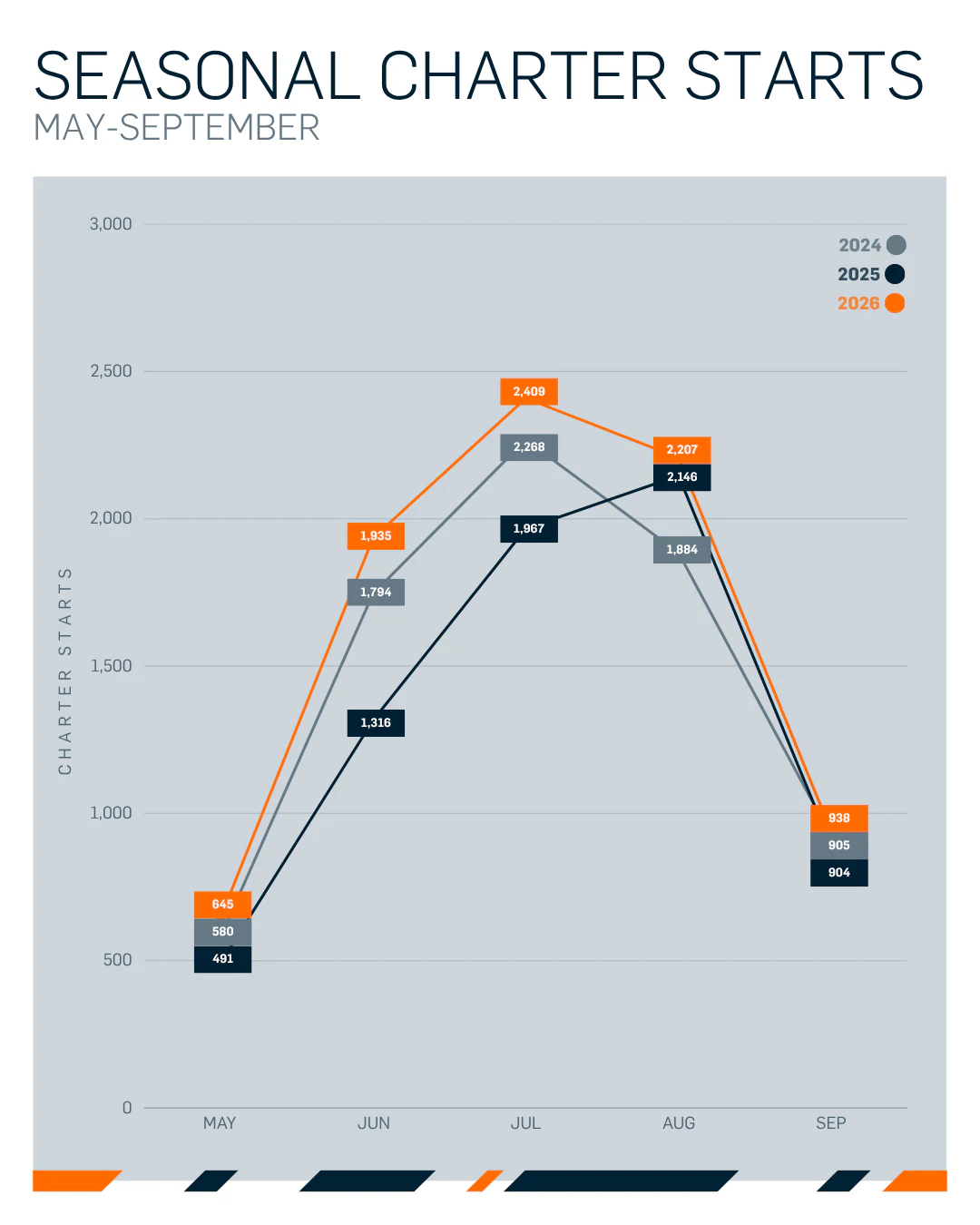
The shape of the season has also changed. In 2025, August represented the peak for charter starts. This year, activity reached its high point in July, building on the earlier strength already evident in June. Previous analysis showed that the proportion of Mediterranean charters taking place between May and July had risen from 54.9% in 2025 to 59.5% in 2026.
Rather than a fundamental change to the traditional Mediterranean calendar, the data points to a slightly earlier and broader peak, with more activity moving into June and July rather than concentrating as heavily around August.
BOOKING WINDOWS
The most striking change in 2026 has been the shortening of the booking window.
As the Mediterranean season approached, clients increasingly delayed decisions until close to departure. In May, 36.3% of bookings were for charters beginning either that month or the following month. That increased to 51.9% in June and reached 66.7% in July.
July consequently became an active booking month, before activity eased in August. A total of 741 bookings were made during August, down 32.6% from July’s 1,099 and 33.9% below August 2025, when 1,121 charters were booked. The proportion relating to same- or next-month departures also fell to 37.9%.
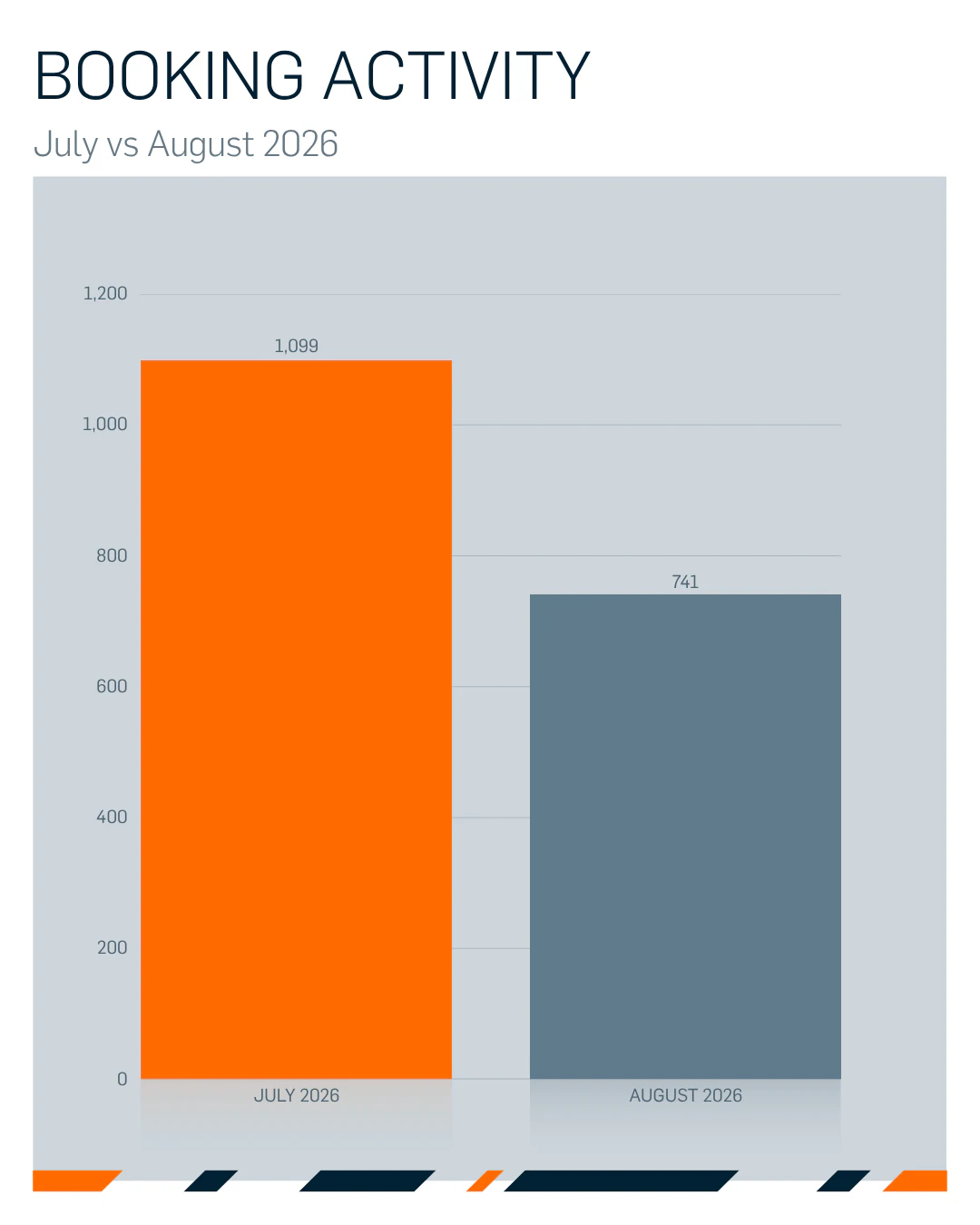
The decline should therefore be viewed in the context of an unusually active July rather than in isolation. Average charter duration remained broadly stable in August at 9.8 days, with a median of eight days, suggesting that the principal change was in booking volume and timing rather than the nature of the charters being booked.
For clients, this late-booking market created opportunities where yachts retained gaps in their calendars, but with an inevitable trade-off: less certainty over a particular yacht, week or itinerary the closer the departure date became. That dynamic was already clearly visible by July.
2027 IS TAKING SHAPE
As the summer peak passed, August also revealed an important counterpoint to the last-minute booking trend: a significant proportion of clients are already planning for next year.
Of all bookings made in August, 43% were for charters taking place in 2027, while a further 1.8% related to 2028 or 2029. Combined, 44.8% of August bookings were for 2027 or later, compared with just 17.5% of July bookings relating to the following year or beyond.
Next summer is already beginning to take shape. June and July 2027 accounted for 163 bookings made during August, with a further 48 for August 2027.
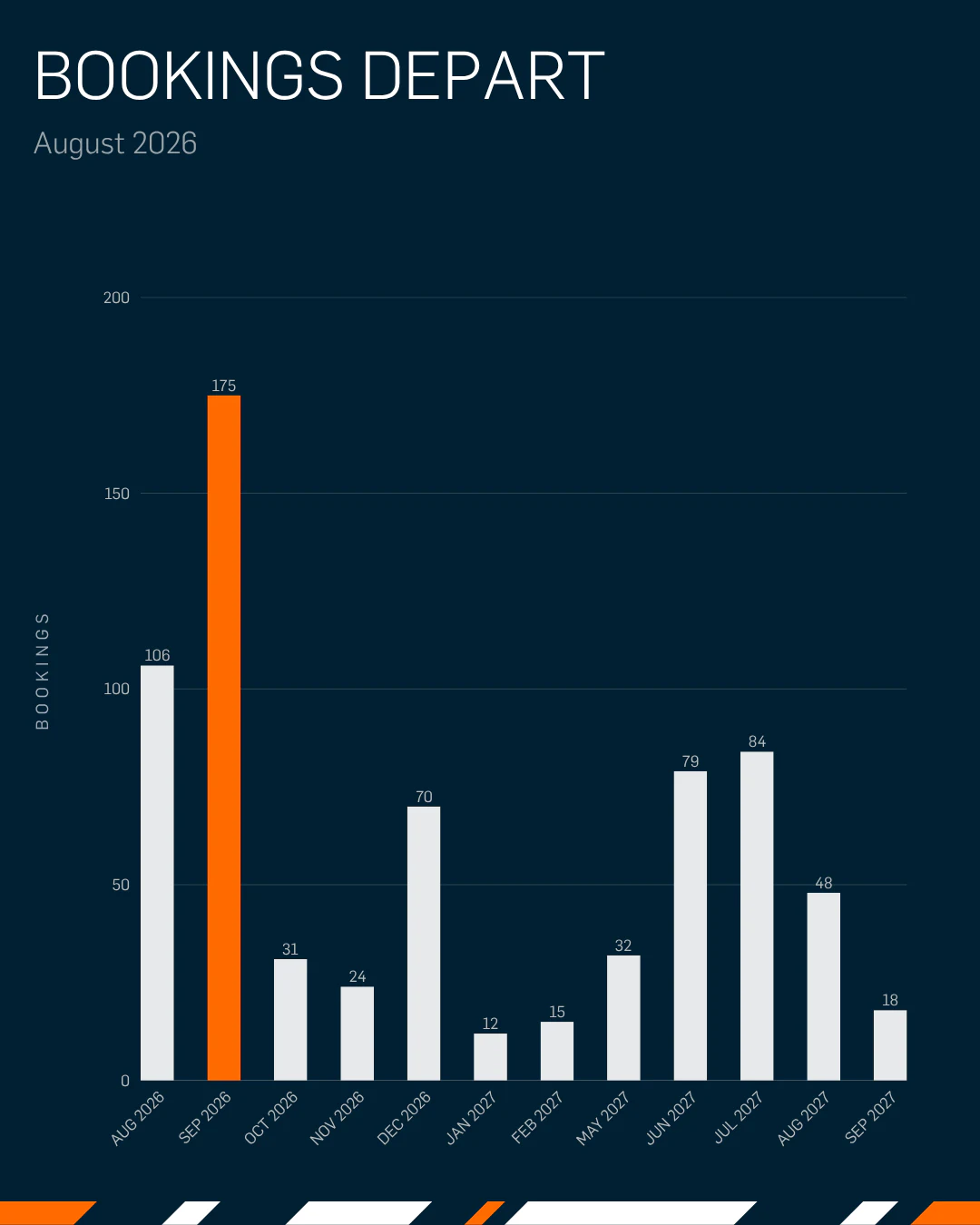
This suggests that it would be too simplistic to characterize the market as having moved permanently towards last-minute booking. Some clients are prepared to wait until close to departure, while others are already securing specific yachts and peak dates almost a year ahead.
That distinction matters. Flexibility can create opportunity for late bookers, but clients with firm requirements around yacht, destination or dates continue to have a strong incentive to plan ahead.
FROM MEDITERRANEAN SUMMER TO WINTER
With September underway, the geographical pattern of bookings is beginning to reflect the seasonal transition from the Mediterranean towards winter cruising grounds.
The Mediterranean still dominated bookings made during August, accounting for 67.5% of the total. The Western Mediterranean remained the largest individual region with 190 bookings, or 25.6%, followed by the Eastern Mediterranean with 177 (23.9%) and the Adriatic with 133 (17.9%).
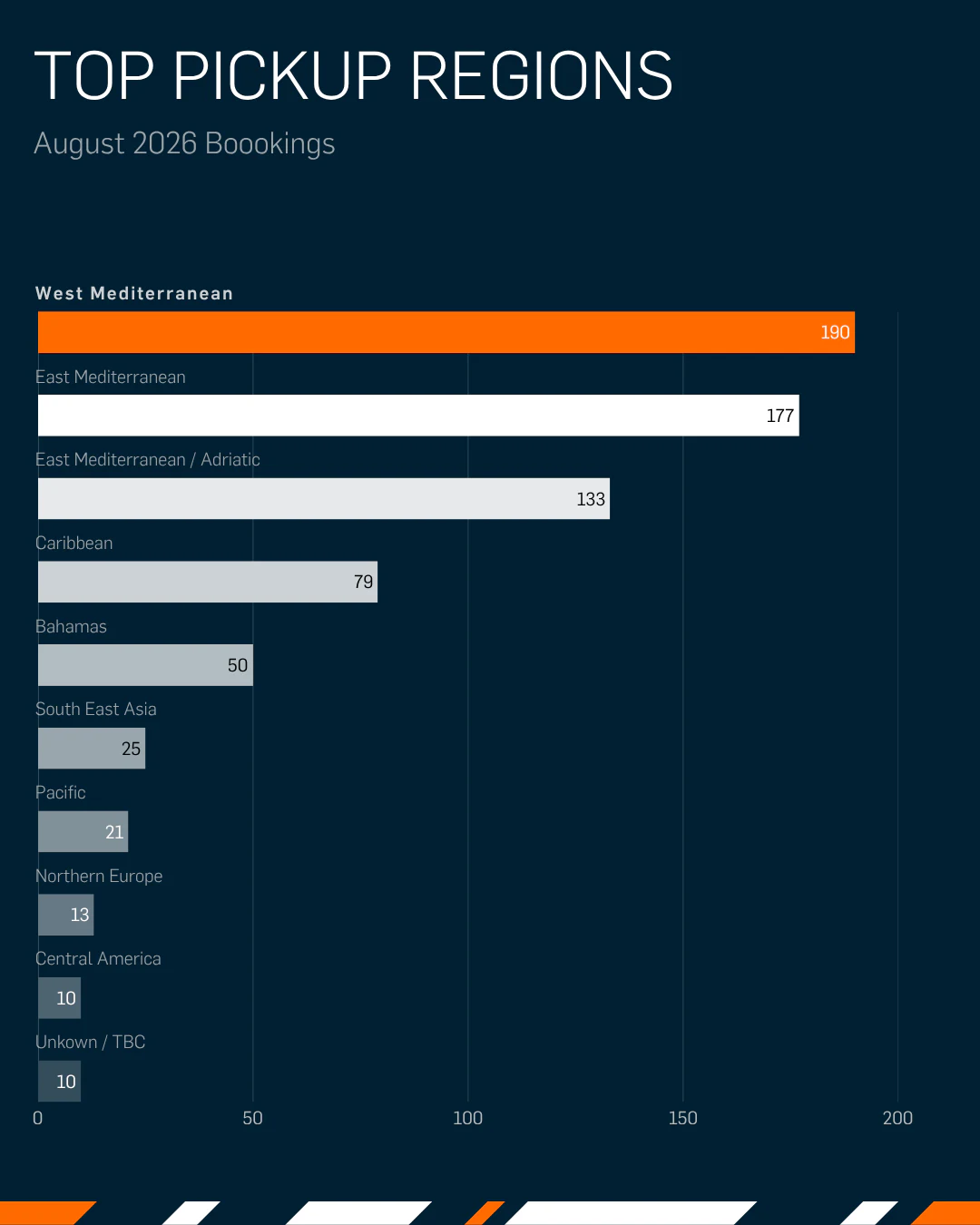
But winter destinations were already becoming increasingly visible. The Caribbean accounted for 79 August bookings (10.7%), with The Bahamas contributing a further 50 (6.7%).
The transition is equally apparent among individual embarkation points. Athens remained the leading location with 116 bookings, and Split (Croatia), followed with 79, but Nassau had already moved into third place with 47 bookings, followed by St Maarten with 31.
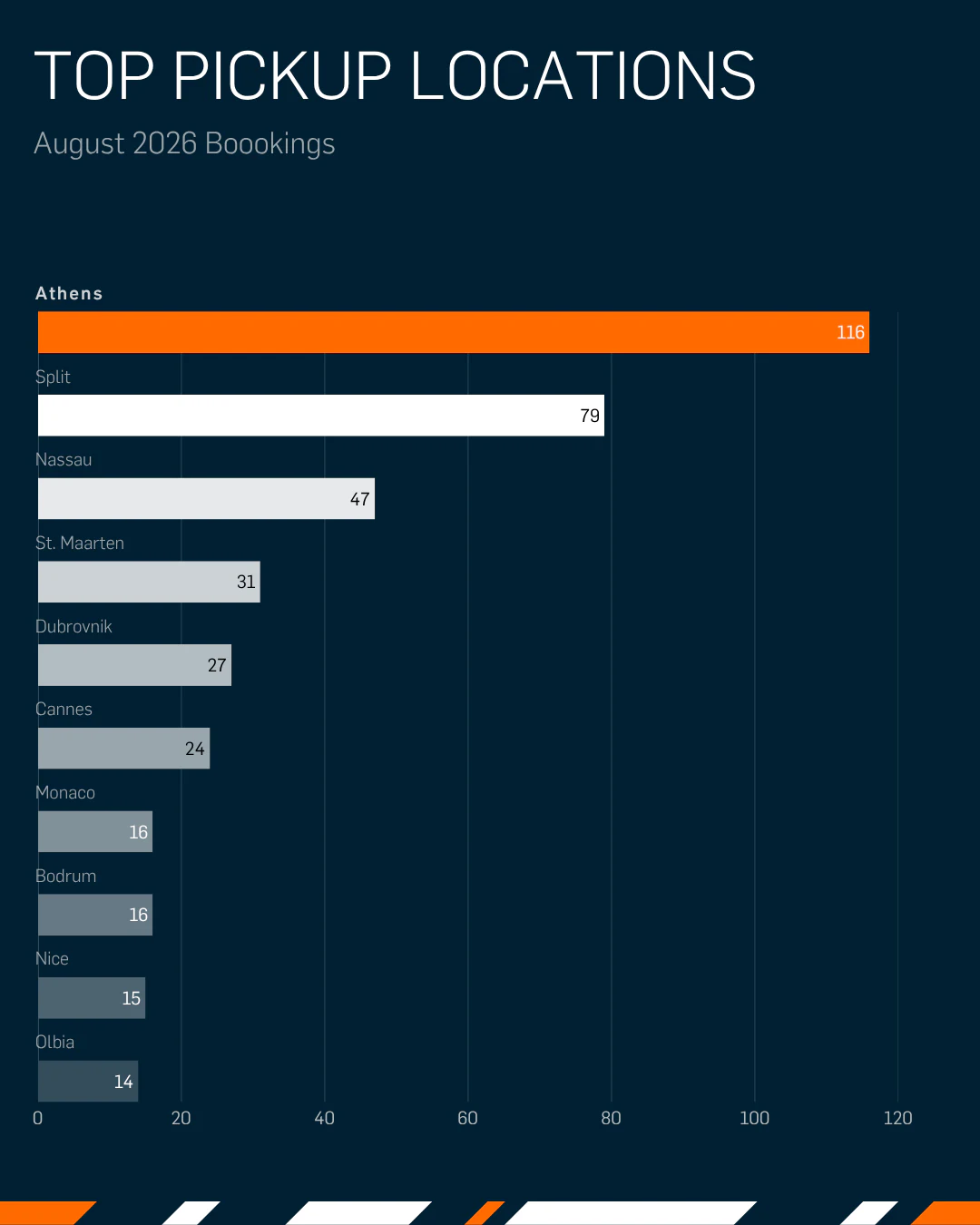
The August data, therefore, captures the charter calendar at an interesting point of transition: Mediterranean activity remained dominant, but forward demand was already beginning to turn towards the Caribbean and The Bahamas.
SIZE
Yacht-size data shows a market still centered firmly around the 98’-164′ (30m–50m) range. Yachts between 131′-164′ (40m–50m) represented the largest individual segment in August, accounting for 31% of bookings, followed by the 98′-131′ (30m-40m) category at 27.9%. Combined, the two segments represented 59% of all August bookings.
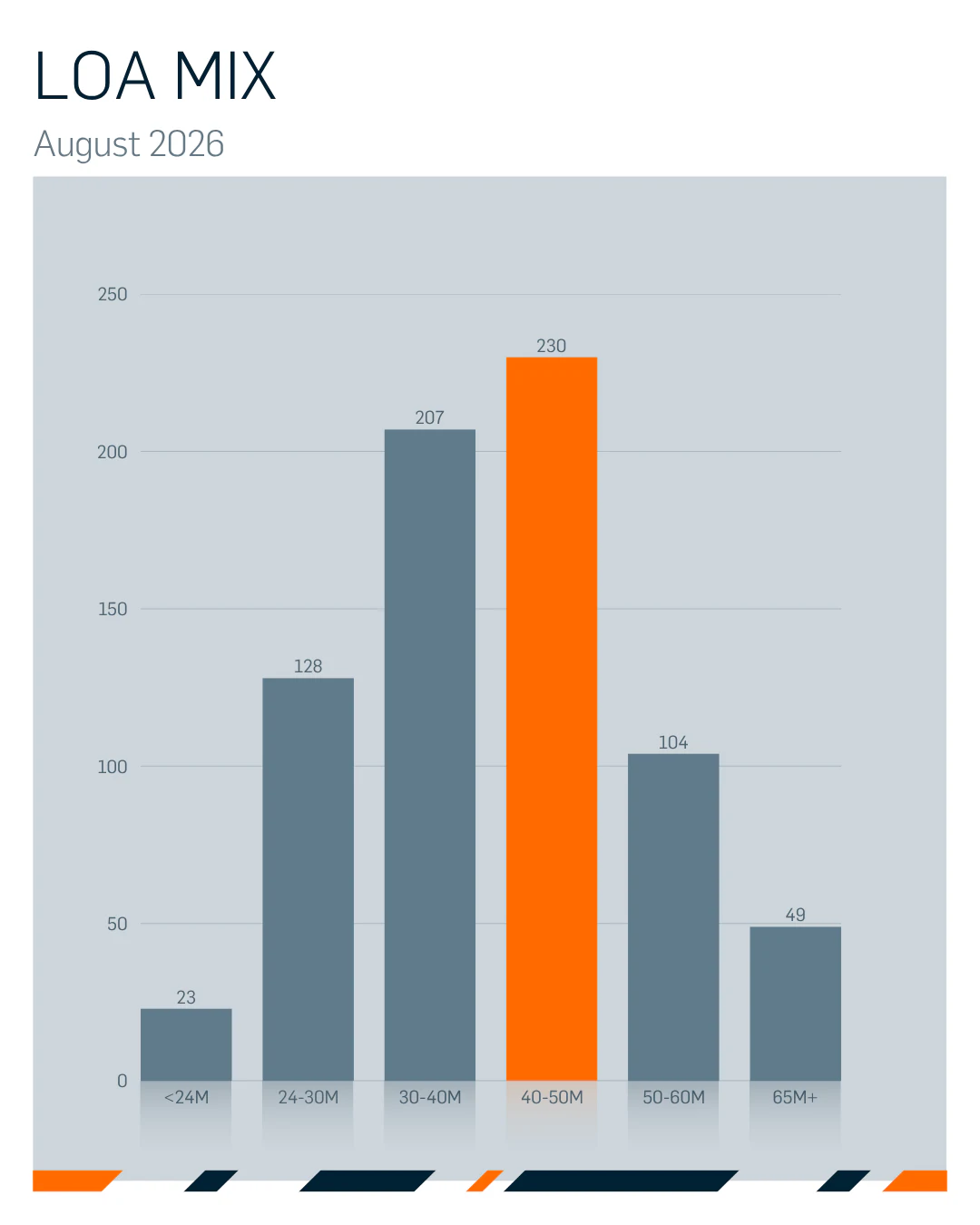
The 164′-213′ (50m-65m) segment accounted for 14.0%, while yacht 213’+ (65m+) represented 6.6%. At the other end of the market, yachts below 98’ (30m) accounted for approximately 20%.
There is, however, a more noticeable difference in charter duration at the very top of the market. Charters aboard yachts over 213’ (65m) averaged 15.1 days, compared with 9.4 days for yachts between 131′-164′ (40m–50m) and 8.8 days in the 98′-131′ (30m-40m) category.
Charter duration remained concentrated around the traditional one-week-plus format. Almost half of August bookings were for eight to ten days, while 31% Were for seven days or fewer.
CHARTER MARKET OUTLOOK
September marks the beginning of a different phase of the charter year. The Mediterranean peak is largely behind us, winter demand is building, and attention is increasingly turning towards 2027.
Eight months into 2026, the charter market has ultimately proved stronger than the cautious start to the year initially suggested. Both charter starts and booked days are comfortably ahead of 2025, while the Mediterranean delivered a strong summer despite clients making decisions progressively closer to departure.
The question now is whether the exceptionally short booking window seen this summer was a temporary response to the particular conditions of 2026 or represents a more lasting change in client behavior. July marked the high point of the last-minute trend, yet by August, almost 45% of new bookings were already for 2027 or beyond.
Rather than moving uniformly towards earlier or later booking, the market appears increasingly divided between advance planners and opportunistic late bookers.
For charter clients, both approaches present opportunities. Greater flexibility can create options close to departure, while those seeking a particular yacht, itinerary or peak week have good reason to look further ahead. With June and July 2027 already attracting meaningful booking activity, next year’s Mediterranean season is beginning to take shape even as the 2026 summer draws to a close.
Market insights and analysis powered by data from Northrop & Johnson’s Deep Data team.
Read Next

Navigator Newsletter Stay informed on all things yachting and luxury lifestyle with the bi-monthly Navigator newsletters.